Introduction
What is a SIP, and why is it becoming one of the most popular investment options for students and beginners? In an era where financial independence is no longer a distant dream but an achievable goal, students are increasingly looking for ways to make their money work for them. Yet, many believe that investing requires large sums of money, deep stock market knowledge, or constant monitoring. This is where a Systematic Investment Plan (SIP) becomes a game-changer. A SIP allows you to invest small amounts regularly, often starting with just ₹500 per month, into mutual funds. For students managing tuition fees, daily expenses, and perhaps a part-time job, SIPs offer an accessible way to begin investing while building the habit of disciplined saving. In this article, we'll explain what a SIP is, how it works, and how students can start their investment journey with just ₹500 a month.
Now that you understand what is a SIP, let's explore how this investment method works and why it has become so popular among students and first-time investors.
What Is a SIP and How Does It Work?
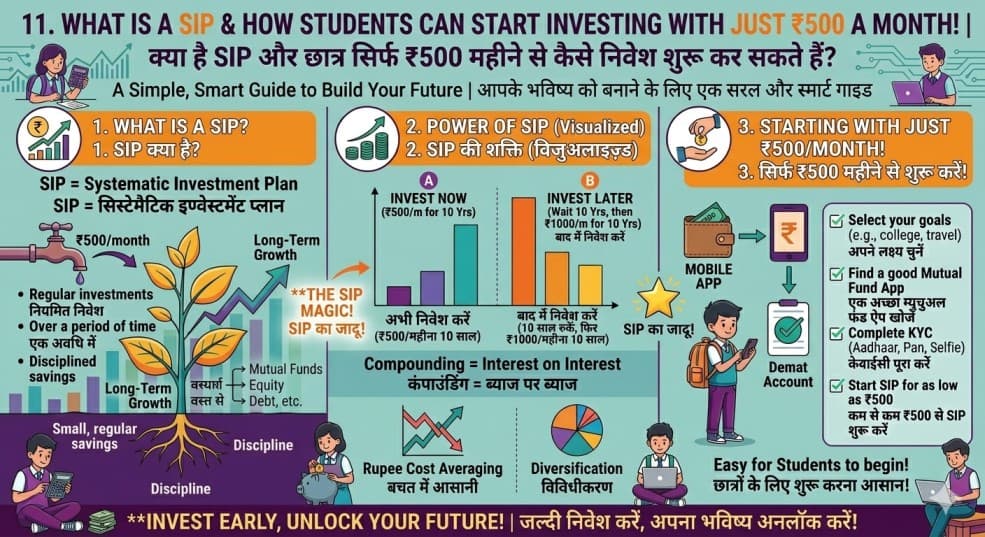
A Systematic Investment Plan (SIP) is an investment strategy offered by mutual funds. Instead of investing a lump sum amount all at once, you commit to investing a fixed amount—say ₹500—at regular intervals, typically monthly. Each installment buys you a certain number of units of the mutual fund, based on the fund's current Net Asset Value (NAV). Over time, this method averages out the cost of your investments, a phenomenon often referred to as rupee cost averaging. When the market is down, your fixed contribution buys more units; when the market is up, it buys fewer. This disciplined approach reduces the risk of trying to time the market, making it an ideal entry point for students with limited capital and limited experience.
Understanding what is a SIP can help students make informed financial decisions and begin investing without needing a large amount of money. The flexibility and affordability of SIPs make them one of the most beginner-friendly investment options available today.
Key Features of a SIP
- Low Entry Barrier: Most mutual funds allow SIPs starting from ₹500, and some even from ₹100.
- Disciplined Saving: Automates your savings, ensuring you invest before you spend.
- Power of Compounding: Your returns generate their own returns over time, accelerating wealth creation.
- Flexibility: You can increase, decrease, pause, or stop your SIP at any time without penalties.
Why Students Should Start a SIP with ₹500
Many students ask, "What is a SIP and why should I start one?" The answer lies in its simplicity, affordability, and ability to build wealth gradually through disciplined investing. Starting early, even with a small amount, harnesses the power of compounding to an extraordinary degree. Consider this: Investing ₹500 per month at an average annual return of 12% for 10 years would grow to approximately ₹1,16,000. But if you start just five years later, you would need to invest significantly more to reach the same corpus. A ₹500 SIP is not about becoming a millionaire overnight; it is about building a habit, learning market dynamics, and creating a foundation for future wealth. Moreover, it teaches financial discipline—a skill that will serve you well throughout your life. With the rise of fintech apps and zero-commission platforms, the process has become simpler than ever, requiring only a smartphone, a PAN card, and a bank account.
Step-by-Step Guide: Starting Your First SIP with ₹500
Before starting your investment journey, it is important to understand what is a SIP and how regular monthly investments can help you achieve long-term financial goals.
Follow these practical steps to begin your investment journey today.
Step 1: Complete Your KYC
Before you can invest, you need to be KYC (Know Your Customer) compliant. This is a one-time process mandated by the Securities and Exchange Board of India (SEBI). You will need your PAN card, Aadhaar card, a recent photograph, and a cancelled cheque or bank statement. You can complete KYC online through platforms like KFintech or CAMS, or through your chosen investment app.
Step 2: Choose the Right Type of Mutual Fund
Not all mutual funds are suitable for small SIPs. For a student starting with ₹500, consider these options:
- Index Funds or ETFs: These passively track a market index like the Nifty 50, offering low expense ratios and diversified exposure. They are ideal for beginners who want to avoid active fund manager risk.
- Large-Cap Funds: These invest in the top 100 companies by market capitalization, providing relative stability.
- Balanced Advantage Funds: These dynamically adjust between equity and debt, offering a cushion during volatility.
Avoid sectoral or thematic funds that concentrate risk, as they require more market knowledge.
Several user-friendly platforms allow you to start a SIP with ₹500. Popular options include Zerodha's Coin, Groww, Paytm Money, and ET Money. Compare their user interface, transaction charges (many are free for direct plans), and the range of funds offered. Always choose a direct plan of a mutual fund instead of a regular plan, as the expense ratio is lower, meaning more of your money stays invested.
Step 4: Set Up Your SIP
Once you have chosen a fund and a platform, you can set up the SIP. You will specify the amount (₹500), the frequency (monthly), and the date of deduction (e.g., the 5th of every month). Link your bank account via auto-debit or UPI mandate. Most platforms confirm the setup instantly, and the first deduction will occur on the chosen date.
Step 5: Monitor and Review Quarterly
While SIPs are meant to be a 'set and forget' strategy, it is wise to review your portfolio every quarter. Check if the fund's performance is consistent with its benchmark. If a fund underperforms for two consecutive years, consider switching. However, avoid reacting to short-term market noise.
Common Mistakes Students Make with SIPs
Even with a small amount, pitfalls exist. Avoid these common errors:
- Stopping the SIP during a market downturn: This defeats the purpose of rupee cost averaging. A downturn is actually an opportunity to buy more units at lower prices.
- Choosing funds based on past returns alone: Past performance is not indicative of future results. Look at the fund's expense ratio, fund manager tenure, and portfolio consistency.
- Not increasing the SIP amount over time: As your income grows (e.g., from a part-time job or internship), increase your SIP amount by even ₹100-₹200. This accelerates your wealth building.
- Ignoring taxes: Gains from equity-oriented mutual funds held for more than one year are subject to Long-Term Capital Gains (LTCG) tax of 10% on gains exceeding ₹1 lakh. Keep this in mind when you eventually withdraw.
Conclusion
If you've been wondering what is a SIP, the answer is simple: it is one of the easiest and most effective ways to start investing. Understanding what is a SIP can help students build financial discipline and create long-term wealth with even a small monthly investment.
A SIP with just ₹500 a month is not merely a financial instrument; it is a mindset shift. It transforms you from a passive spender to an active investor, leveraging time and consistency to build a solid financial foundation. For students, this is the perfect starting point—low risk, high learning, and immense potential. The journey of a thousand miles begins with a single step, and in the world of investing, that step is a ₹500 SIP. So open that app, complete your KYC, and let your money start working for you today. Your future self will thank you.