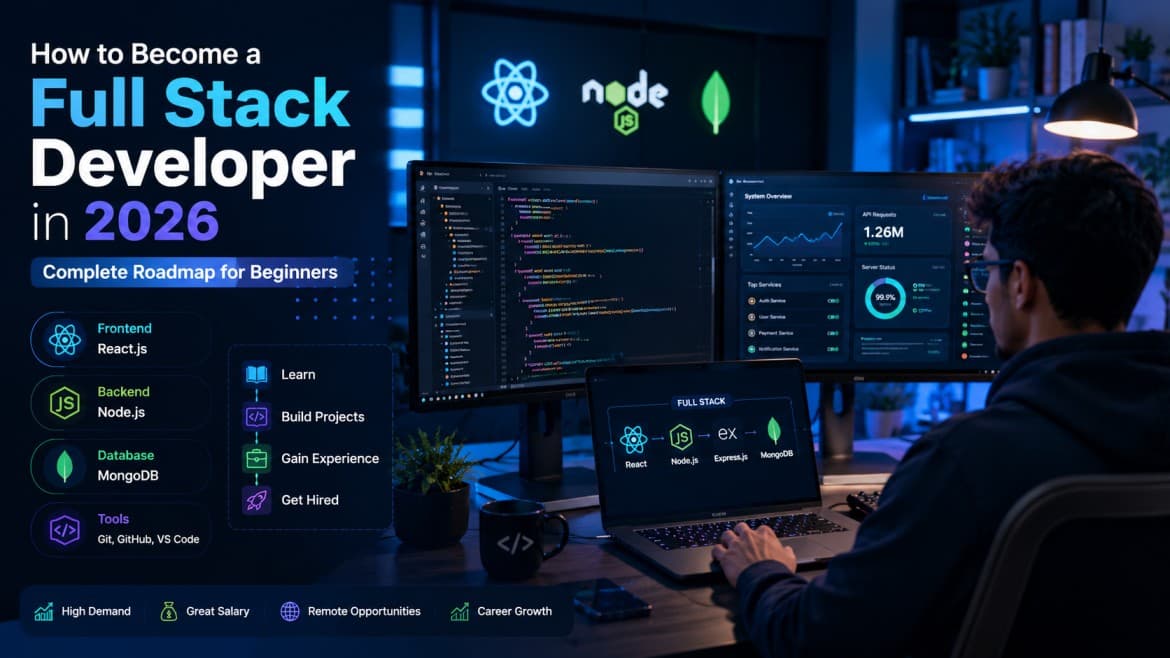
How to Become a Full Stack Developer in 2026: Complete Roadmap for Beginners
Introduction
Full Stack Developer Roadmap 2026 is one of the most searched career paths among students and aspiring software engineers. As businesses continue to move online, the demand for skilled full stack developers is growing rapidly. A full stack developer can build both the frontend and backend of a web application, making them highly valuable in today's technology industry.
If you are a beginner wondering how to start your journey, this guide will explain everything you need to know.
What Is a Full Stack Developer?
A Full Stack Developer is a professional who works on both the client side (frontend) and server side (backend) of web applications. Instead of focusing on a single area, full stack developers understand the complete development process.
Their responsibilities include:
- Building user interfaces
- Developing backend APIs
- Managing databases
- Deploying applications
- Fixing bugs and improving performance
Because they can handle multiple aspects of development, companies actively seek skilled full stack developers.
Why Full Stack Development Is a Great Career in 2026
Technology companies, startups, and enterprises all need web applications. This has created strong demand for developers who can work across the entire development stack.
Benefits include:
- High salary potential
- Remote work opportunities
- Freelancing options
- Startup opportunities
- Continuous career growth
This is why the Full Stack Developer Roadmap 2026 is becoming increasingly important for students.
Step 1: Learn HTML, CSS, and JavaScript
Every full stack developer starts with frontend development.
HTML
HTML provides the structure of a website.
CSS
CSS controls design, layout, and responsiveness.
JavaScript
JavaScript adds interactivity and dynamic functionality.
These three technologies form the foundation of web development.
Step 2: Learn Modern Frontend Frameworks
After mastering JavaScript, learn a modern framework.
React.js
React is currently one of the most popular frontend libraries in the world.
Benefits:
- Component-based architecture
- Fast performance
- Large community support
- High industry demand
Students following the Full Stack Developer Roadmap 2026 should prioritize React.
Step 3: Learn Backend Development
Frontend handles what users see, while backend manages data and business logic.
Popular backend technologies:
- Node.js
- Express.js
- PHP
- Laravel
- Python
Node.js remains one of the best choices for beginners due to its popularity and JavaScript ecosystem.
Step 4: Learn Databases
Databases store application data.
Important databases include:
MongoDB
A flexible NoSQL database commonly used with Node.js.
MySQL
A reliable relational database used by millions of websites.
Every Full Stack Developer Roadmap 2026 should include database management skills.
Step 5: Learn Git and GitHub
Version control is essential for modern development.
Git helps developers:
- Track code changes
- Collaborate with teams
- Manage projects efficiently
GitHub allows developers to showcase projects and build professional portfolios.
Step 6: Build Real Projects
Projects help transform theory into practical skills.
Examples:
- Portfolio Website
- Task Management App
- Blog System
- E-Commerce Website
- Learning Management System
Employers value real-world projects more than certificates alone.
Step 7: Learn APIs
Modern applications communicate through APIs.
Important concepts:
- REST APIs
- Authentication
- JSON
- Third-party integrations
API development is a core skill in the Full Stack Developer Roadmap 2026.
Step 8: Learn Deployment
After building applications, you must deploy them online.
Popular platforms:
- Vercel
- Netlify
- DigitalOcean
- AWS
Deployment knowledge helps developers launch production-ready applications.
Step 9: Understand Basic Cybersecurity
Security awareness is essential.
Learn:
- Authentication
- Authorization
- Data protection
- Secure coding practices
Secure applications improve user trust and reliability.
Step 10: Create a Professional Portfolio
Your portfolio should include:
A strong portfolio can significantly improve job opportunities.
Career Opportunities
After completing the Full Stack Developer Roadmap 2026, students can apply for:
- Frontend Developer
- Backend Developer
- Full Stack Developer
- Software Engineer
- Web Application Developer
- Freelance Developer
Conclusion
TheFull Stack Developer Roadmap 2026 provides a clear path for beginners who want to enter the technology industry. By learning HTML, CSS, JavaScript, React, Node.js, databases, APIs, and deployment, students can build valuable skills and create successful careers. Consistent practice, project building, and continuous learning are the keys to becoming a successful full stack developer.