Loading...
Start with the simplest SQL commands. You'll learn what a relational database is, how to select all or specific columns and rows, sort results, and remove duplicates. By the end, you'll be able to explore any table like a pro.

Go beyond basic WHERE. Master operators like LIKE, BETWEEN, IN, IS NULL, and combine conditions with AND/OR. Understand precedence and negation. You'll write precise queries that get exactly the data you need.
Transform data on the fly using arithmetic, string operations, and column aliases. Then learn aggregate functions (COUNT, SUM, AVG, MAX, MIN) and grouping with GROUP BY. You'll answer business questions like 'What is the average order value per city?'
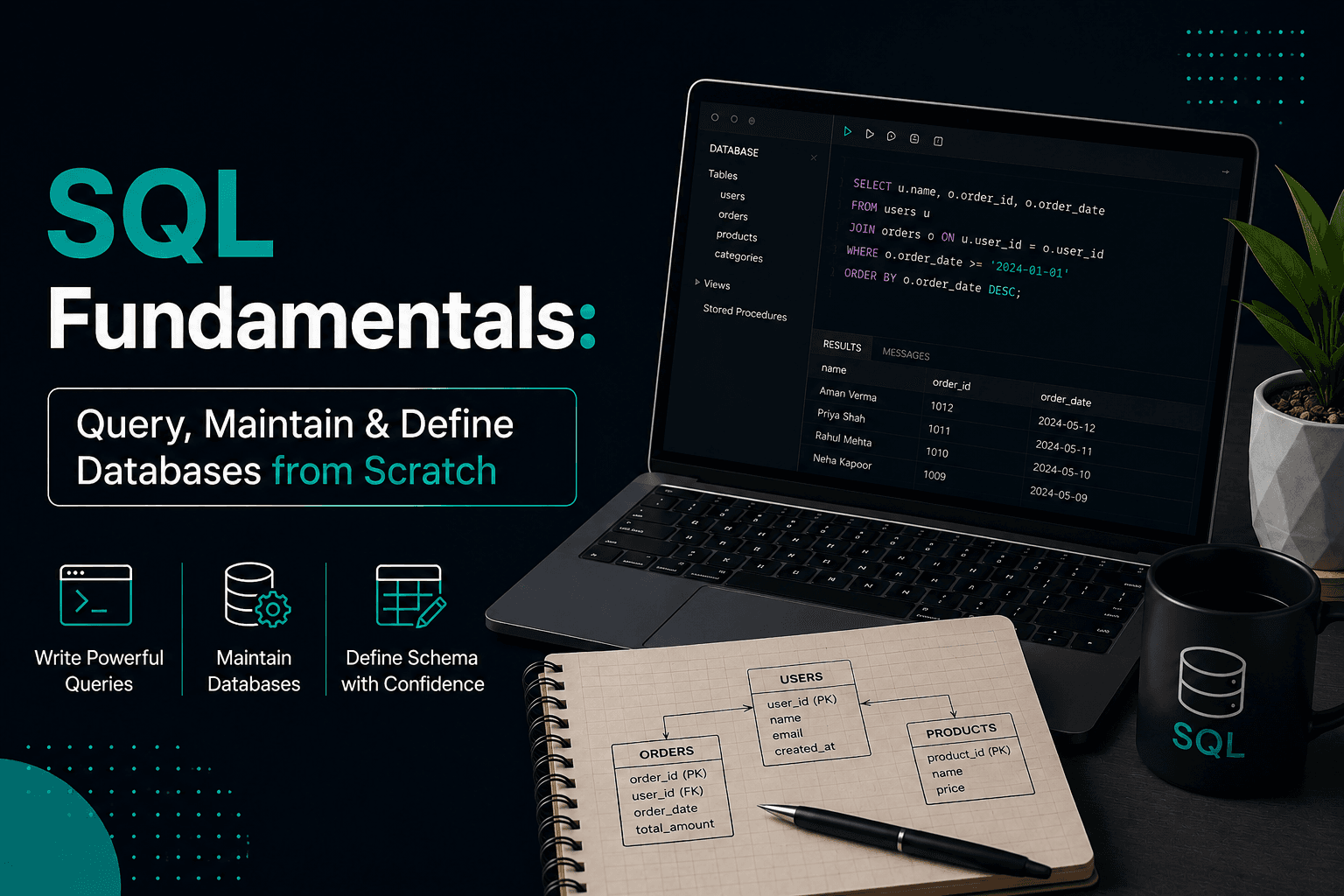
Real databases have many related tables. Learn to combine them using JOINs (INNER, LEFT, RIGHT, FULL), table aliases, and UNION. By the end, you'll be able to answer questions like 'Which customers placed orders in the last month?' by joining Customers and Orders.
Learn to embed one query inside another (subqueries) for powerful filtering. Then switch to data maintenance: INSERT, UPDATE, DELETE with transactions for safety. You'll handle real-world scenarios like updating a customer's address or deleting old records.
Move from user to designer. Learn to create tables with proper data types, enforce rules with constraints (PRIMARY KEY, FOREIGN KEY, UNIQUE, NOT NULL), speed up queries with indexes, and simplify complex queries with views. You'll design a small database from scratch.
Saurav Singh
All prices include a 18% platform fee