Loading...
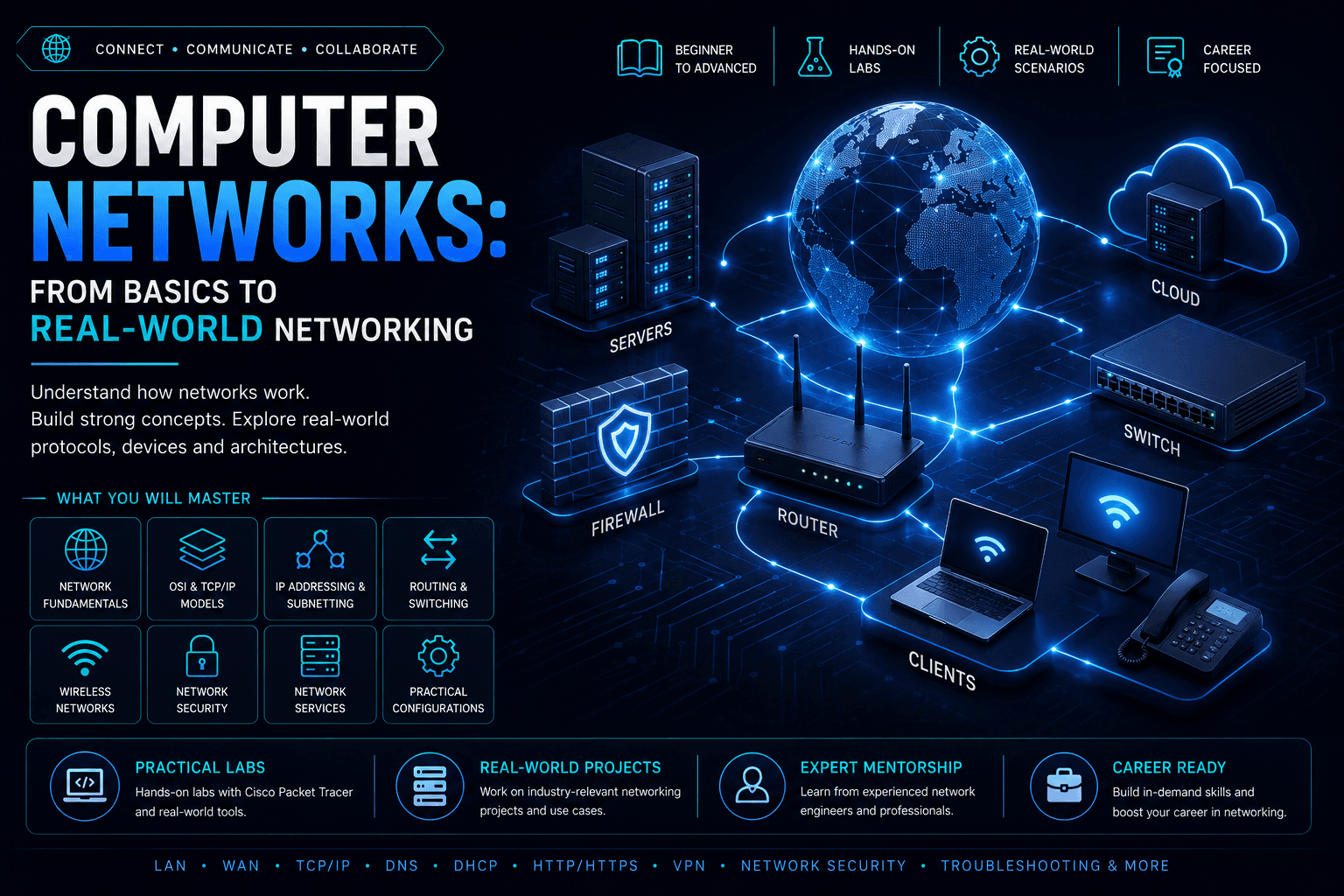
We start with the big picture: what networks are, why they matter, and how they're classified. Then we dive into the physical layer — the actual cables and wireless signals that carry your data. You'll learn how Jio's fiber and Airtel's 4G towers work. By the end, you'll be able to identify the right transmission medium for a given scenario.

The data link layer ensures reliable data transfer over a physical link. You'll learn how data is framed, errors are detected and corrected, and multiple devices share the same medium (like Wi-Fi). We'll use Indian examples like Wi-Fi in a crowded Bengaluru cafe. By the end, you'll be able to calculate checksums and understand how Ethernet works.
The network layer is the backbone of the internet. You'll learn how packets are routed from source to destination, how IP addresses work, and how subnetting helps manage networks. We'll use examples from Indian companies' internal networks and ISPs. By the end, you'll be able to subnet a /24 network for a small office and understand how Google's BGP routing works.
The transport layer ensures end-to-end communication. You'll learn how TCP provides reliable data transfer (like downloading a file) while UDP sacrifices reliability for speed (like live streaming). We'll analyze real packet captures. By the end, you'll be able to explain why Zoom uses UDP and why banking apps use TCP.
The application layer is what users interact with. You'll learn how HTTP powers the web, how DNS translates domain names, how email works, and the basics of network security (RSA). We'll use Indian examples like IRCTC's website, Gmail, and Aadhaar authentication. By the end, you'll be able to explain how a URL becomes a webpage and how HTTPS protects your data.
Admin User
All prices include 18% GST as per Indian tax regulations