Introduction
If you have ever wondered what is programming, you are not alone. Many beginners hear terms like coding, software development, and programming languages but feel confused about where to start. This guide explains what is programming in simple language so that absolute beginners can understand the basics and begin their learning journey with confidence.
Understanding what is programming is important because programming is one of the most valuable skills in today's digital world. From websites and mobile apps to games and artificial intelligence, programming powers the technology we use every day. By the end of this guide, you will understand what programming is, why it matters, and how you can start learning it.
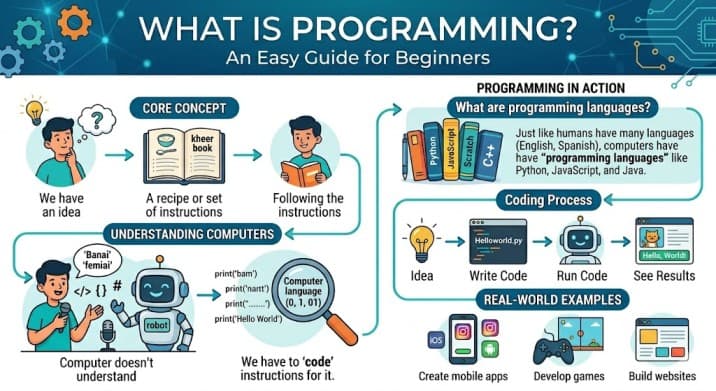
At its core, programming (also called coding) is the process of giving a computer a list of instructions to follow. Computers are incredibly fast and obedient, but they are also very literal. They need clear, step-by-step directions to perform even simple tasks. Programming is the art of writing those directions in a language the computer can understand.
Think of it like a recipe. When you bake a cake, you follow a recipe: mix flour, add eggs, bake at 350°F. If you miss a step or add the wrong ingredient, the cake might not turn out well. Similarly, a computer program is a recipe — a sequence of commands that, when executed correctly, produces a desired result. The difference is that computers follow instructions at lightning speed and never get bored.
Programming vs. Coding: What's the Difference?
When people ask what is programming, they often confuse it with coding. While the two are closely related, programming involves much more than simply writing code.
You'll often hear the terms programming and coding used interchangeably, but there's a subtle difference. Coding is the act of writing the actual code — typing the lines of text in a programming language. Programming is the broader process that includes planning, designing, testing, and debugging that code. So coding is a part of programming, but programming also involves problem-solving and logical thinking.
Understanding what is programming helps you see how technology works and why programming skills are valuable in today's job market.
Programming isn't just for computer scientists or tech wizards. It's a skill that can benefit anyone, regardless of their field. Here are a few compelling reasons to start:
- Automate boring tasks — Write a script to rename hundreds of files, organize your emails, or download data from the web. Programming saves you time.
- Build something from scratch — Ever wanted to create your own website, mobile app, or game? Programming makes that possible.
- Boost your career — Programming skills are in high demand across industries like healthcare, finance, education, and entertainment. It can open doors to new job opportunities.
- Improve your problem-solving — Programming teaches you how to break big problems into small, manageable pieces. That logical thinking helps in everyday life too.
- Understand the digital world — We live in a world run by software. Knowing how it works gives you a deeper appreciation and control over the technology you use.
How Does Programming Actually Work?
To fully understand what is programming, it is helpful to know how programming languages communicate with computers.
Computers don't speak English, Spanish, or any human language. They speak in binary — a system of 0s and 1s. But writing in binary is incredibly tedious and error-prone. That's why we use programming languages. These are specially designed languages that are easier for humans to read and write, yet can be translated into binary for the computer to execute.
Popular Programming Languages for Beginners
Once you understand what is programming, choosing a beginner-friendly language becomes much easier.
There are hundreds of programming languages, but some are better suited for beginners. Here are a few you might encounter:
- Python — Known for its simple, readable syntax. It's great for web development, data analysis, artificial intelligence, and automation. Many beginners start here because it feels almost like writing English.
- JavaScript — The language of the web. If you want to make websites interactive, JavaScript is essential. It runs in every browser.
- Scratch — Not a text-based language, but a visual block-based system. Perfect for absolute beginners (especially kids) to learn programming concepts without typing.
- HTML & CSS — Technically not programming languages, but they are markup and style sheet languages used to structure and design web pages. They're often the first step for aspiring web developers.
For this guide, we'll focus on Python because it's widely recommended for newcomers. But the concepts you learn with one language transfer easily to others.
Learning what is programming becomes more exciting when you start writing actual code.
Your First Program: Hello, World!
A tradition in programming is to start with a simple program that displays the words "Hello, World!" on the screen. It's a tiny victory that proves your setup works. In Python, it looks like this:
print("Hello, World!")That's it. When you run this code, the computer outputs: Hello, World!. You've just given your first instruction. Feels good, right?
Key Concepts Every Beginner Should Know
Before you dive deeper, let's cover a few fundamental ideas that appear in almost every programming language:
Variables
A variable is like a labeled box where you can store information. For example, you can store your name in a variable called my_name and then use it later. In Python: my_name = "Alex". Now whenever you use my_name, the computer knows it means "Alex".
Data Types
Computers need to know what kind of data they're dealing with. Common types include:
- Strings — Text, like "Hello" or "123 Main St".
- Integers — Whole numbers, like 42 or -7.
- Floats — Decimal numbers, like 3.14 or 0.001.
- Booleans — True or False values.
Conditionals (If-Else)
Conditionals allow your program to make decisions. For example: if age >= 18: print("You can vote"). The computer checks the condition and runs the appropriate code.
Loops
Loops let you repeat an action multiple times without writing the same code over and over. A for loop can print "Hello" 10 times with just a few lines of code.
Functions
Functions are reusable blocks of code that perform a specific task. You can create your own function to calculate the area of a circle, and then use it whenever needed. This keeps your code organized and efficient.
How to Start Learning Programming Today
Now that you know what is programming, the next step is practicing regularly and building small projects.
Ready to write your first real program? Here's a simple plan to get started:
- Choose a language — Python is a fantastic choice for beginners. It's free and has a huge community.
- Set up your environment — Install Python from python.org and use a simple text editor like VS Code or even the built-in IDLE.
- Follow a beginner tutorial — GreyAcademy offers a free introductory course that walks you through the basics step by step.
- Practice every day — Even 15 minutes a day makes a difference. Try small challenges like printing your name or calculating your age in days.
- Don't be afraid to make mistakes — Errors are part of learning. Every programmer, from beginner to expert, sees error messages. Read them, fix them, and move on.
Common Myths About Programming
Let's clear up a few misconceptions:
- "You have to be a math genius." — Not true. Basic arithmetic and logical thinking are enough for most programming tasks. Advanced math is only needed for specialized fields like data science or game physics.
- "It's too hard for me." — Programming is challenging, but so is any new skill. With patience and practice, anyone can learn it.
- "You need a fancy computer." — Any modern laptop or desktop will work. Even a cheap Chromebook can run Python online.
Conclusion
If someone asks you what is programming, you can now confidently explain that it is the process of creating instructions that tell computers how to perform tasks. It's a skill that empowers you to create, automate, and solve problems. As a beginner, the most important step is to start — write that first line of code, make your first mistake, and keep going. The world of programming is vast, exciting, and welcoming to newcomers. At GreyAcademy, we're here to guide you every step of the way. So go ahead, open your editor, and say print("Hello, World!"). The best way to truly understand what is programming is through hands-on practice and consistent learning. Your journey has just begun.