Introduction
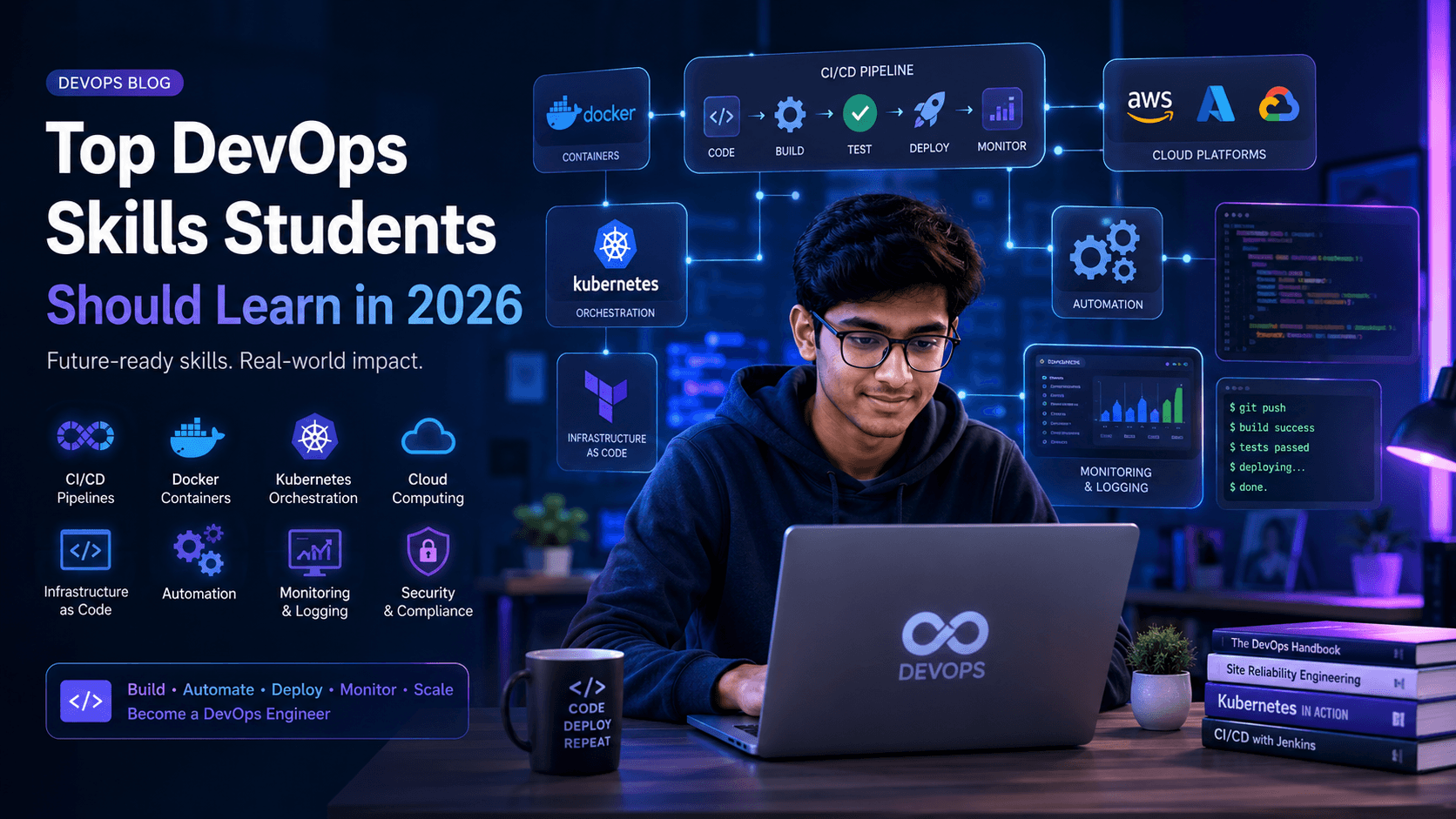
The Top DevOps Skills Students Should Learn in 2026 are becoming increasingly important as businesses continue adopting cloud computing, automation, and modern software delivery practices. DevOps has transformed the way organizations build, test, deploy, and maintain applications, creating a strong demand for skilled professionals across industries. Students who start learning DevOps early can gain a competitive advantage in the job market by mastering technologies such as CI/CD, Docker, Kubernetes, cloud platforms, automation tools, and monitoring systems. In this guide, we will explore the most valuable DevOps skills that students should focus on in 2026 to build a successful and future-ready technology career.
DevOps is no longer just a buzzword—it's a career-defining field. If you're a student or beginner looking to break into tech, understanding the DevOps Skills Students Should Learn in 2026 will set you apart. The industry is evolving fast, and by 2026, certain skills will be non-negotiable. In this guide, we'll walk you through the top DevOps skills to master, from cloud platforms to automation tools. Ready to future-proof your career? Let's dive in!
1. Cloud Computing Fundamentals
Cloud platforms like AWS, Azure, and Google Cloud are the backbone of modern DevOps. By 2026, nearly every company will be running at least part of their infrastructure in the cloud. Start with the basics: compute, storage, networking, and security. Learn to deploy virtual machines, set up load balancers, and manage databases. Our courses offer hands-on labs to practice these skills. Mastering cloud computing is one of the top DevOps Skills Students Should Learn in 2026.
2. Containerization with Docker & Kubernetes
Containers have revolutionized software deployment. Docker allows you to package applications with their dependencies, while Kubernetes orchestrates them at scale. In 2026, knowing how to write Dockerfiles and manage Kubernetes clusters will be essential. Focus on concepts like pods, services, deployments, and namespaces. Practice by containerizing a simple web app and deploying it on a local cluster. This skill is a must-have in the list of DevOps Skills Students Should Learn in 2026.
3. CI/CD Pipelines
Continuous Integration and Continuous Deployment (CI/CD) automate the process of testing and releasing code. Tools like Jenkins, GitLab CI, and GitHub Actions are industry standards. Learn to set up pipelines that build, test, and deploy applications automatically. Understand the importance of automated testing and how to integrate security scans. CI/CD is a core DevOps practice, making it one of the critical DevOps Skills Students Should Learn in 2026.
4. Infrastructure as Code (IaC)
Manually configuring servers is a thing of the past. IaC tools like Terraform and Ansible let you define infrastructure in code, making it repeatable and version-controlled. Learn to write Terraform configurations to provision cloud resources, and use Ansible for configuration management. IaC reduces errors and speeds up deployments. For students, this is a game-changer. Add it to your list of DevOps Skills Students Should Learn in 2026.
5. Monitoring & Observability
Once applications are deployed, you need to know they're running smoothly. Monitoring tools like Prometheus, Grafana, and the ELK Stack (Elasticsearch, Logstash, Kibana) help you track metrics, logs, and traces. Learn to set up dashboards, create alerts, and troubleshoot issues. Observability is about understanding the system's internal state from external outputs. This skill is vital for any DevOps engineer. Check out other articles on our blog for more insights.
6. Scripting & Automation
Automation is at the heart of DevOps. Learn scripting languages like Python, Bash, or PowerShell to automate repetitive tasks. Write scripts to manage servers, parse logs, or interact with APIs. Understanding version control with Git is also crucial. Automation saves time and reduces human error. As a student, building a portfolio of automation scripts will impress employers. These foundational skills are part of the DevOps Skills Students Should Learn in 2026.
Automation & Scripting
Automation is one of the core principles of DevOps. In modern software development, manually performing repetitive tasks such as deployments, server configuration, testing, and monitoring can be time-consuming and prone to human error. Automation helps teams improve efficiency, consistency, and reliability across the entire software delivery lifecycle.
Scripting is the foundation of automation. DevOps engineers use scripting languages to automate routine tasks, manage infrastructure, and streamline workflows. Popular scripting languages include Python, Bash, PowerShell, and JavaScript. Among these, Python is particularly popular due to its simplicity, extensive libraries, and strong community support.
In 2026, organizations are expected to rely even more heavily on automation to manage complex cloud environments, containerized applications, and large-scale deployments. DevOps professionals who can write effective scripts and build automation pipelines will have a significant advantage in the job market.
Some common automation use cases include:
-
Automated application deployments
-
Server provisioning and configuration
-
Continuous Integration and Continuous Deployment (CI/CD)
-
Infrastructure monitoring and alerting
-
Backup and recovery operations
-
Security compliance checks
-
Log collection and analysis
Popular automation tools used in DevOps include:
-
Jenkins
-
GitHub Actions
-
GitLab CI/CD
-
Ansible
-
Terraform
-
Puppet
-
Chef
For students entering the DevOps field, learning basic Linux commands, shell scripting, and Python programming is highly recommended. Building small automation projects, such as automated backups or deployment scripts, can provide practical experience and strengthen problem-solving skills.
As organizations continue adopting cloud-native technologies and large-scale automation strategies, scripting and automation skills will remain essential for every DevOps engineer. Mastering these skills enables teams to deliver software faster, reduce operational overhead, and maintain reliable systems at scale.
Key Skills to Learn:
Conclusion
The tech landscape is shifting, and DevOps is leading the charge. By focusing on these six areas—cloud computing, containerization, CI/CD, IaC, monitoring, and automation—you'll be well-prepared for 2026. Start small, practice consistently, and build real projects. The DevOps Skills Students Should Learn in 2026 are within your reach. Embrace the journey, and you'll open doors to exciting opportunities. Happy learning!