Introduction
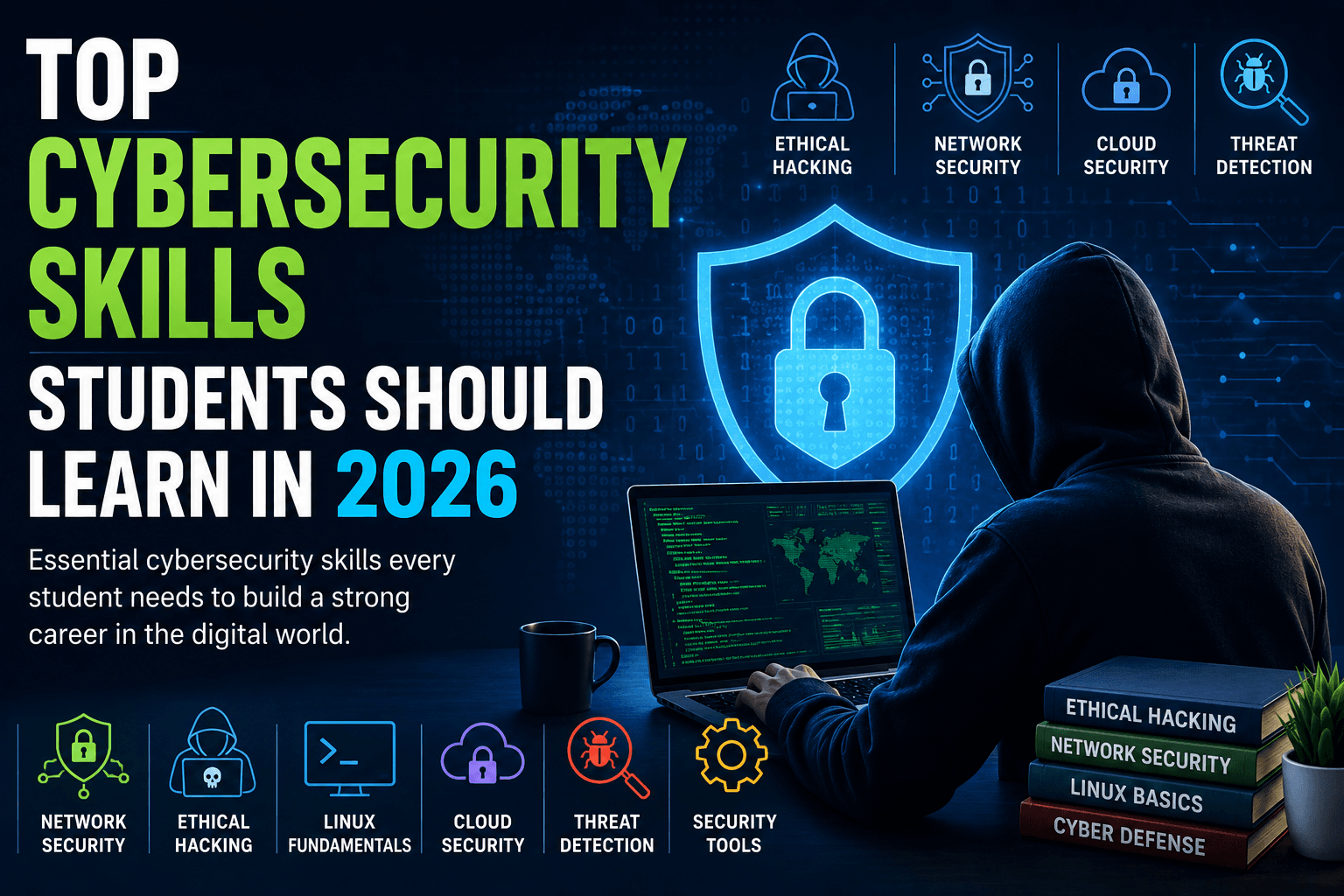
Cybersecurity Skills Students Should Learn in 2026 are becoming increasingly important as digital technology continues to grow across industries. Students who develop cybersecurity knowledge early can build strong career opportunities and prepare for future technology jobs.
Cybersecurity is no longer limited to IT professionals. Businesses, educational institutions, and organizations now depend on security experts to protect systems, networks, and sensitive information. In this guide, we will explore the most valuable cybersecurity skills students should learn in 2026 and how to start building a successful career in this field.
Are you a student wondering which career path will be future-proof? Look no further than cybersecurity. With cyber threats evolving daily, the demand for skilled professionals is skyrocketing. In this post, we'll explore the Cybersecurity Skills Students Should Learn in 2026 to stand out in the job market. Whether you're a complete beginner or have some tech knowledge, these skills will set you up for success. Let's dive in!
1. Cloud Security Fundamentals
As more companies move to the cloud, securing these environments is critical. Learn the basics of AWS, Azure, or Google Cloud security. Understand identity and access management (IAM), encryption, and compliance. Cybersecurity Skills Students Should Learn in 2026 include cloud security because it's one of the fastest-growing niches. Start with free resources like our Cloud Security Basics course.
Key Topics to Master
- Cloud architecture and shared responsibility model
- Securing storage and databases
- Threat detection in cloud environments
2. Ethical Hacking and Penetration Testing
Ethical hacking involves thinking like a hacker to find vulnerabilities before malicious actors do. This hands-on skill is highly valued. Learn tools like Kali Linux, Metasploit, and Burp Suite. Practice on platforms like Hack The Box. Cybersecurity Skills Students Should Learn in 2026 must include ethical hacking because it teaches you how attackers operate. Check out our beginner's guide to ethical hacking for a step-by-step plan.
What to Focus On
- Network scanning and enumeration
- Web application testing (OWASP Top 10)
- Social engineering simulations
3. Network Security and Defense
Understanding how networks work is foundational. Learn about firewalls, intrusion detection systems (IDS), and VPNs. Get comfortable with protocols like TCP/IP, DNS, and HTTP. Cybersecurity Skills Students Should Learn in 2026 include network security because every organization needs to protect its data in transit. Practice setting up a home lab to simulate attacks and defenses.
- Wireshark for packet analysis
- Nmap for network mapping
- Snort for intrusion detection
4. AI and Machine Learning in Cybersecurity
Artificial intelligence is transforming cybersecurity. Learn how AI can detect anomalies, automate responses, and predict threats. Understanding basic ML concepts will give you an edge. Cybersecurity Skills Students Should Learn in 2026 should include AI because it's becoming essential for handling large-scale data. Start with Python and libraries like Scikit-learn.
Practical Applications
- Building a spam filter
- Detecting malware using ML models
- Automating incident response
5. Incident Response and Forensics
When a breach happens, incident responders are the first line of defense. Learn how to contain threats, eradicate them, and recover systems. Digital forensics involves collecting and analyzing evidence. Cybersecurity Skills Students Should Learn in 2026 include incident response because it's a critical part of any security team. Practice with tools like Autopsy and FTK.
Steps to Learn
- Understand the incident response lifecycle
- Practice with capture-the-flag (CTF) challenges
- Study real-world breach reports
6. Soft Skills: Communication and Problem-Solving
Technical skills alone aren't enough. Cybersecurity professionals must explain risks to non-technical stakeholders and work in teams. Develop your writing and presentation skills. Cybersecurity Skills Students Should Learn in 2026 include soft skills because they make you more effective. Join online communities and contribute to discussions.
How to Improve
- Write technical blog posts
- Participate in cybersecurity forums
- Take a course on business communication
Conclusion
The cybersecurity field is vast, but focusing on these Cybersecurity Skills Students Should Learn in 2026 will give you a strong start. Remember to stay curious and keep learning. For more guidance, explore our full range of cybersecurity courses. The future is secure—if you prepare today!
Career Opportunities in Cybersecurity
Cybersecurity has become one of the fastest-growing career fields in the technology industry. As businesses continue moving online, the demand for skilled cybersecurity professionals is increasing.
Popular career options include:
-
Cybersecurity Analyst
-
Ethical Hacker
-
Security Engineer
-
Network Security Specialist
-
Cloud Security Engineer
-
Security Consultant
-
Incident Response Analyst
Students who start learning cybersecurity early can build practical experience and improve future career opportunities.
Best Tools Students Can Learn
Learning tools helps students gain real-world exposure.
Useful cybersecurity tools include:
-
Wireshark for network monitoring
-
Linux for system management
-
Git for collaboration
-
Cloud platforms for security practice
-
Virtual labs for safe learning
Students should focus on understanding concepts instead of memorizing tools.
Tips to Learn Cybersecurity Faster
Students can improve learning speed by following practical methods:
-
Build mini security projects
-
Learn networking fundamentals
-
Practice problem-solving
-
Read security news and updates
-
Create a portfolio
Practical experience often becomes more valuable than theory.
Frequently Asked Questions
Is cybersecurity a good career in 2026?
Yes, cybersecurity continues to offer strong growth and demand.
Can students learn cybersecurity without experience?
Yes, students can start with networking, Linux, and security basics.
Do students need programming?
Basic programming knowledge can help but is not mandatory in the beginning.
Conclusion
Cybersecurity Skills Students Should Learn in 2026 continue becoming more important across industries. Students who build practical security knowledge, networking skills, cloud understanding, and real-world projects can prepare for future technology careers.