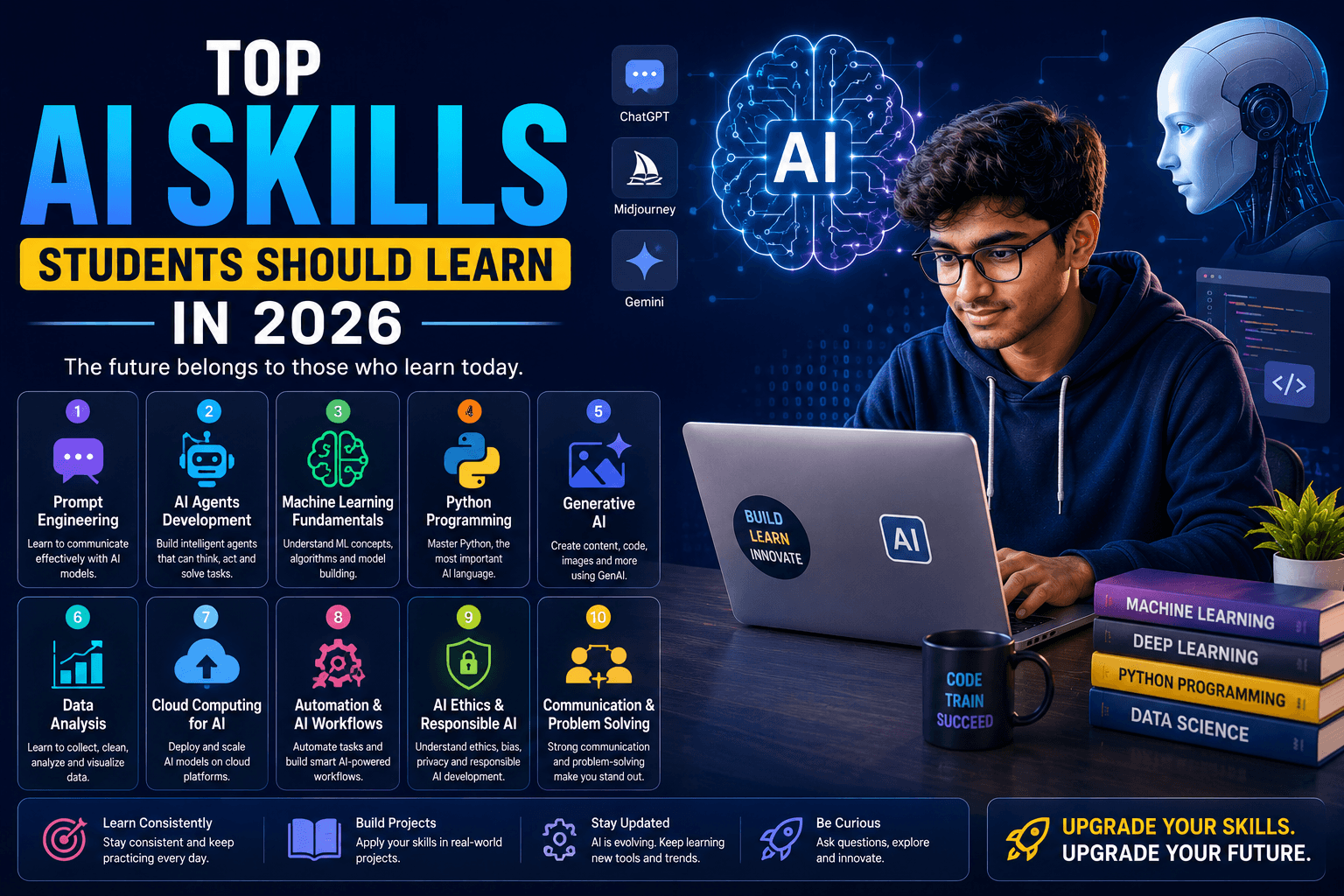
Introduction
The Top AI Skills Students Should Learn in 2026 are becoming essential for anyone who wants to build a successful career in technology. As Artificial Intelligence continues to transform industries such as healthcare, finance, education, and software development, students who learn AI-related skills early will gain a significant competitive advantage. From Prompt Engineering and AI Agents to Machine Learning, Python Programming, and Generative AI, these skills are helping shape the future of work. This guide explores the Top AI Skills Students Should Learn in 2026 and explains how students can start building expertise in these high-demand technologies.
Artificial intelligence is reshaping industries at lightning speed. As a student, you might wonder which abilities will give you an edge in the job market. That's why we've curated this guide on the Top AI Skills Students Should Learn in 2026. Whether you're a beginner or already dabbling in tech, these skills will help you thrive in an AI-driven world.
Why Learn AI Skills in 2026?
AI is no longer just for engineers. From healthcare to finance, every field uses AI to solve problems. By 2026, demand for AI-literate professionals will skyrocket. Learning these skills now means you'll be ready for roles that don't even exist yet. Plus, it's an exciting time to experiment with cutting-edge tools.
1. Machine Learning Fundamentals
Machine learning (ML) is the backbone of AI. Understanding how algorithms learn from data is crucial. Start with supervised and unsupervised learning, then explore neural networks. Platforms like our AI courses offer beginner-friendly projects. Even basic ML knowledge will set you apart.
2. Prompt Engineering
Prompt engineering is the art of crafting inputs to get desired outputs from AI models like ChatGPT. It's a top AI skill because it boosts productivity. Learn to write clear, specific prompts. Practice with different models and refine your technique. This skill is invaluable for students in any major.
3. Data Literacy and Analysis
AI runs on data. Knowing how to collect, clean, and interpret data is essential. Start with Excel, then move to Python libraries like Pandas. Understand data ethics and bias. Data literacy complements other AI skills and helps you make informed decisions.
4. Natural Language Processing (NLP)
NLP enables machines to understand human language. It powers chatbots, translation tools, and sentiment analysis. Learn tokenization, embeddings, and transformers. Try building a simple text classifier. NLP is a growing field with many applications.
5. Computer Vision Basics
Computer vision lets AI interpret images and videos. It's used in self-driving cars, medical imaging, and more. Start with image classification and object detection. Use tools like OpenCV and pre-trained models. Even basic projects can be impressive.
6. AI Ethics and Responsible AI
As AI spreads, ethical considerations become critical. Learn about bias, fairness, transparency, and privacy. Understand regulations like GDPR. Companies need professionals who can build responsible AI. This skill shows you care about impact, not just technology.
How to Start Learning
Begin with free resources: online courses, YouTube tutorials, and our other articles. Pick one skill and build a project. Join AI communities to stay motivated. Remember, consistency beats intensity. The Top AI Skills Students Should Learn in 2026 are within your reach—start today!
Conclusion
The future belongs to those who embrace AI. By focusing on these skills, you'll not only boost your resume but also gain a deeper understanding of the world. So, dive in, experiment, and enjoy the journey. Your future self will thank you.
Career Opportunities for Students with AI Skills
The demand for Artificial Intelligence professionals is growing rapidly across industries. Companies are actively hiring individuals who can work with AI tools, machine learning models, automation systems, and data-driven technologies. Students who start learning AI skills early can position themselves for exciting career opportunities in the future.
Some of the most popular AI-related career paths include AI Engineer, Machine Learning Engineer, Data Scientist, Prompt Engineer, AI Product Manager, Automation Specialist, and AI Research Assistant. These roles are becoming increasingly important as organizations adopt AI-powered solutions to improve efficiency and innovation.
One of the biggest advantages of learning AI is that it can be applied in almost every industry. Healthcare organizations use AI for disease prediction and medical analysis, financial institutions use AI for fraud detection and risk assessment, while e-commerce companies leverage AI for personalized recommendations and customer support automation.
Students do not need to wait until graduation to start building AI experience. By creating projects, participating in hackathons, contributing to open-source projects, and earning relevant certifications, they can build a strong portfolio that attracts recruiters and employers.
The AI revolution is creating new opportunities every year. Students who continuously learn and adapt to emerging technologies will be better prepared for future careers. Investing time in developing AI skills today can lead to higher-paying jobs, greater career flexibility, and opportunities to work on innovative technologies that shape the future.
Final Thoughts
The Top AI Skills Students Should Learn in 2026 will play a crucial role in shaping future careers. Students who invest time in learning Prompt Engineering, AI Agents, Machine Learning, Python, Generative AI, and Cloud Computing will be better prepared for the rapidly evolving technology industry. By focusing on the Top AI Skills Students Should Learn in 2026, students can build valuable expertise, improve employability, and stay ahead in an AI-driven world.