Introduction
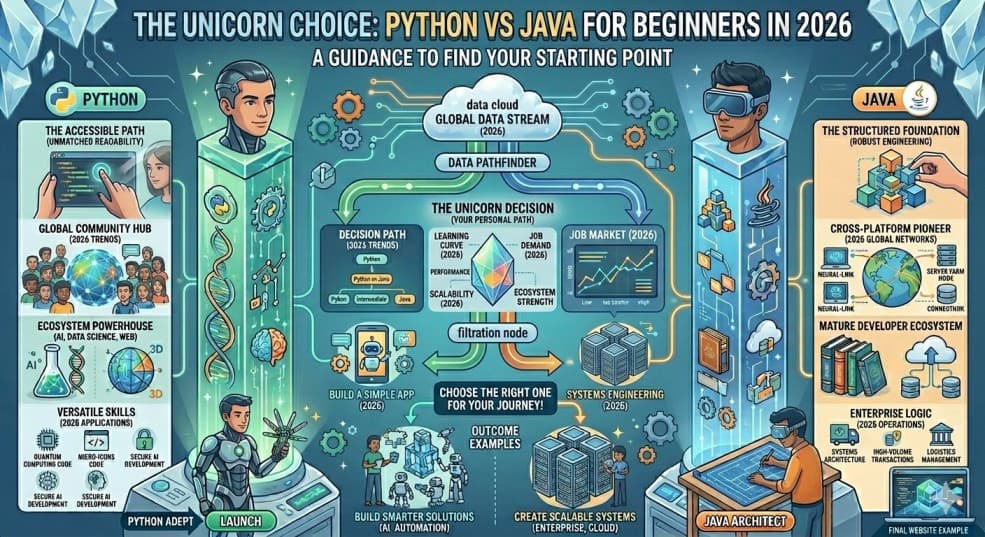
Python vs Java for Beginners is one of the most searched programming comparisons in 2026, and for good reason. Every aspiring developer faces the same pivotal question: Which programming language should I learn first? Both Python and Java dominate the tech landscape, but they cater to different learning styles, career paths, and project requirements. This comprehensive Python vs Java for Beginners guide provides a data-driven, experience-backed comparison to help you choose the right language and start your coding journey with confidence.
Readability and Simplicity
Python’s syntax mirrors plain English, making it exceptionally approachable for newcomers. You can write a functional program in a few lines of code without wrestling with curly braces or semicolons. For example, a simple “Hello, World!” in Python is just print('Hello, World!'). This low barrier to entry lets beginners focus on logic rather than boilerplate.
Rapid Prototyping and Versatility
Python’s dynamic typing and extensive standard library enable rapid prototyping. Whether you’re building a web scraper, a data analysis script, or a machine learning model, Python has a library — think Flask, Pandas, or TensorFlow — that accelerates development. In 2026, Python continues to dominate data science, AI, and automation, fields with soaring demand.
Community and Learning Resources
Python boasts one of the largest, most beginner-friendly communities. Platforms like GreyAcademy offer interactive Python courses that gamify learning. You’ll find countless tutorials, forums, and open-source projects to support your journey.
Why Java Remains a Powerhouse
Strict Structure and Discipline
Java enforces object-oriented principles from day one. You must define classes, methods, and types explicitly. While this can feel verbose — public class HelloWorld { public static void main(String[] args) { System.out.println("Hello, World!"); } } — it instills strong programming habits. For beginners who plan to work on large-scale enterprise systems, Java’s structure is a long-term asset.
Java’s compiled nature and mature JVM (Java Virtual Machine) deliver consistent performance. It powers Android apps, back-end systems for banks, and big data frameworks like Apache Hadoop. In 2026, Java remains the backbone of enterprise software, offering stable, high-paying jobs.
Static Typing and Error Prevention
Java’s static type system catches errors at compile time, reducing runtime surprises. This is especially valuable for beginners who might accidentally misuse variables. The Integrated Development Environment (IDE) support — with tools like IntelliJ IDEA — provides real-time feedback, helping you learn correct syntax faster.
In any Python vs Java for Beginners comparison, evaluating factors such as learning curve, career opportunities, and real-world applications is essential for making the right choice.
Head-to-Head Comparison: Key Factors for 2026
Learning Curve
- Python: Gentle. You can write useful scripts after a few hours. Ideal for non-CS majors or hobbyists.
- Java: Steeper. Expect to spend more time understanding classes, access modifiers, and memory management.
Job Market and Salaries
- Python: High demand in AI, data science, and web development (Django). Average entry-level salary: $85,000–$110,000.
- Java: Dominates enterprise, fintech, and Android. Average entry-level salary: $90,000–$120,000.
Project Types
- Python: Data dashboards, automation scripts, AI models, APIs.
- Java: E-commerce platforms, banking systems, Android apps, large-scale web services.
Community and Longevity
Both languages have robust communities and decades of staying power. Python is the rising star; Java is the established titan. In 2026, neither is going away.
Which One Should You Choose in 2026?
This Python vs Java for Beginners guide is designed to help new developers select the language that best aligns with their goals and interests.
Choose Python If…
- You want to enter data science, AI, or machine learning.
- You prefer rapid experimentation and immediate results.
- You’re learning programming as a secondary skill (e.g., for biology, finance, or design).
- You value simplicity and a large ecosystem of libraries.
Choose Java If…
- You aim for a career in enterprise software, Android development, or backend engineering.
- You want a language that enforces strict discipline and prepares you for complex systems.
- You value long-term job stability and opportunities in large organizations.
- You’re comfortable with a steeper initial learning curve.
“The best first language is the one that keeps you coding. Python hooks you with speed; Java builds your foundation. Both are valid, but your choice should align with your end goal.” — GreyAcademy Curriculum Team
No matter which language you choose, the key is consistent practice. If you are still unsure after reading this Python vs Java for Beginners comparison, try building a small project in each language to discover which one feels more natural. At GreyAcademy, we offer structured paths for both Python and Java. Our Python for Beginners track covers fundamentals through real-world projects, while our Java Foundations course emphasizes object-oriented design and debugging. Both include hands-on labs, quizzes, and community support.
Conclusion
In this Python vs Java for Beginners comparison, both languages are excellent choices for aspiring developers in 2026. Python offers a gentle, versatile entry point, while Java provides discipline and enterprise readiness. Your decision should hinge on your career aspirations and learning style. Remember: the language you choose is just a tool — your curiosity and persistence will determine your success. Start your journey today with GreyAcademy, and master the language that unlocks your potential.