Introduction
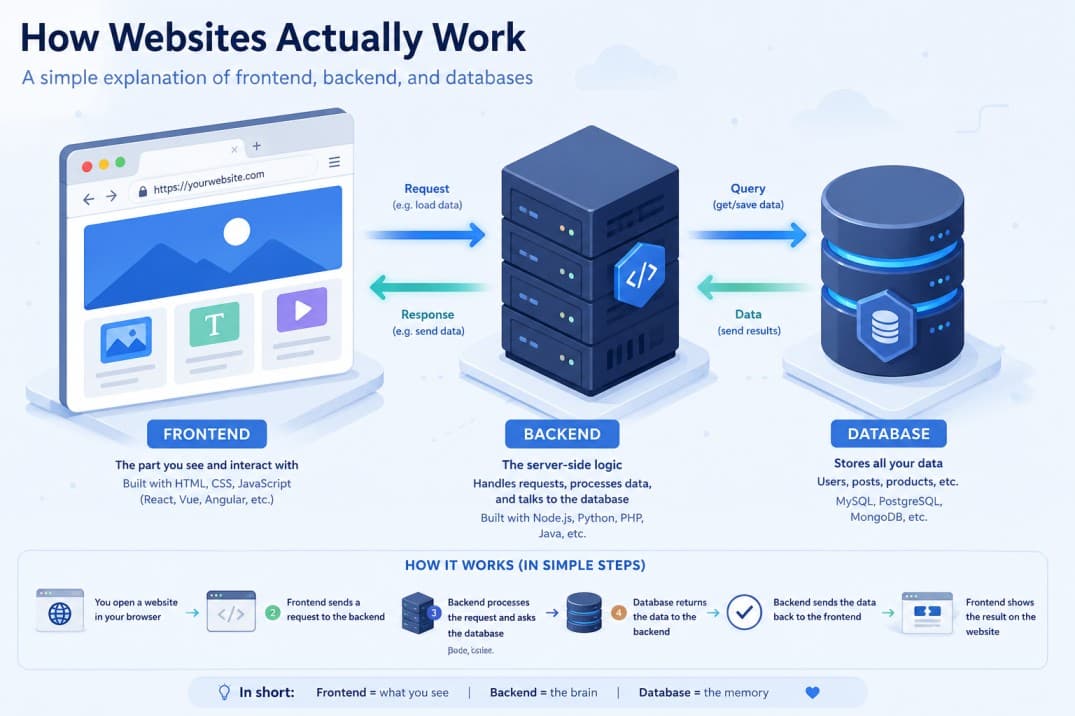
Have you ever opened a website and wondered, “How does this all work?” You type a URL, press Enter, and within seconds a beautiful page appears. It feels like magic, but it’s actually a clever combination of three main layers: the frontend, the backend, and the database. In this post, we’ll peel back the curtain and explain each part in plain English. By the end, you’ll see the web in a whole new light.
What is the Frontend?
The frontend is everything you see and interact with on a website — the colors, buttons, text, images, and animations. Think of it as the storefront of a shop. It’s what greets you and makes the experience enjoyable.
How the Frontend Works
Frontend developers use three core technologies:
- HTML (HyperText Markup Language) — the structure. It’s like the skeleton of a page, defining headings, paragraphs, links, and images.
- CSS (Cascading Style Sheets) — the styling. It adds colors, fonts, layouts, and makes everything look polished.
- JavaScript — the behavior. It makes things interactive, like dropdown menus, form validation, and live updates.
When you visit a site, your browser downloads these files and renders them into the page you see. It all happens locally on your device.
What is the Backend?
Now, let’s step behind the scenes. The backend is the part of the website that runs on a server — a powerful computer that stores and processes data. If the frontend is the storefront, the backend is the back office where orders are processed, inventory is checked, and receipts are printed.
How the Backend Works
Backend code is written in languages like Python, Ruby, PHP, Java, or Node.js (JavaScript on the server). Its job is to listen for requests from the frontend (like “show me the latest blog posts”) and send back the right response.
For example, when you log into a website, your frontend sends your username and password to the backend. The backend checks that information, decides if it’s correct, and then tells the frontend: “Yes, let them in!” or “No, wrong password.”
The backend also handles business logic — calculations, user permissions, and connecting to the database.
What is a Database?
A database is where the website stores its data permanently. Think of it as a giant, organized filing cabinet. It holds user profiles, product catalogs, blog posts, comments, and more.
How Databases Work
Most websites use a relational database like MySQL or PostgreSQL. Data is stored in tables with rows and columns — similar to a spreadsheet. For example, a “Users” table might have columns for ID, name, email, and password.
When the backend needs data (e.g., “find the user with email ‘alice@example.com’”), it sends a query written in a language called SQL (Structured Query Language). The database finds the matching row and sends it back to the backend.
There are also NoSQL databases like MongoDB, which store data in a more flexible format (like JSON documents). They’re popular for apps that need to scale quickly.
Putting It All Together: A Real-World Example
Let’s walk through what happens when you search for a product on an online store:
- You type a URL — Your browser sends a request to the server.
- The backend receives the request — It sees you want the search results page.
- The backend asks the database — “Find all products that match ‘wireless headphones’.”
- The database returns results — A list of matching products.
- The backend packages the data — It might combine the product list with HTML templates.
- The frontend renders the page — Your browser shows a beautiful list of headphones with prices and images.
All of this happens in less than a second!
Why This Matters for Beginners
Understanding these three layers helps you see the big picture. Whether you want to become a frontend developer, a backend developer, or a full-stack developer (someone who does both), knowing how they fit together is your first step.
“The web is not magic — it’s just a conversation between a browser, a server, and a database.”
At GreyAcademy, we have courses that dive deep into each layer. Start with HTML and CSS, then explore JavaScript, and eventually build your own backend with Python or Node.js. The journey is exciting, and you’ll be amazed at what you can create.
Conclusion
We’ve covered a lot: the frontend (what you see), the backend (the logic and processing), and the database (where data lives). Next time you click a link, remember the silent teamwork happening behind the screen. Keep learning, stay curious, and happy coding!
Ready to start building? Check out GreyAcademy’s beginner-friendly web development track.