Introduction
Are you wondering how to become a data analyst in 2026? The demand for data analysts is skyrocketing, and companies across every industry need professionals who can turn raw data into actionable insights. Whether you're a student exploring career options or a beginner looking to switch fields, this guide will walk you through everything you need to know. By the end, you'll have a clear roadmap to launch your data analyst career.
What Does a Data Analyst Do?
A data analyst collects, processes, and analyzes data to help organizations make informed decisions. Typical responsibilities include:
- Cleaning and organizing raw data
- Performing exploratory data analysis
- Creating visualizations and dashboards
- Presenting findings to stakeholders
- Using statistical methods to identify trends
Data analysts work in fields like finance, healthcare, e-commerce, and technology. If you enjoy solving puzzles and working with numbers, this role could be a perfect fit.
Essential Skills for a Data Analyst in 2026
To answer how to become a data analyst effectively, you need a mix of technical and soft skills. Here are the must-haves:
Technical Skills
- SQL – The backbone of data querying. You must be able to write complex queries to extract and manipulate data.
- Excel – Still widely used for data cleaning and basic analysis.
- Python or R – For statistical analysis, automation, and machine learning basics.
- Data Visualization – Tools like Tableau, Power BI, or Python libraries (Matplotlib, Seaborn) to create compelling visuals.
- Statistics – Understanding probability, distributions, hypothesis testing, and regression.
Soft Skills
- Critical Thinking – Ask the right questions and interpret results meaningfully.
- Communication – Explain complex findings to non-technical stakeholders.
- Attention to Detail – Avoid errors that can mislead decisions.
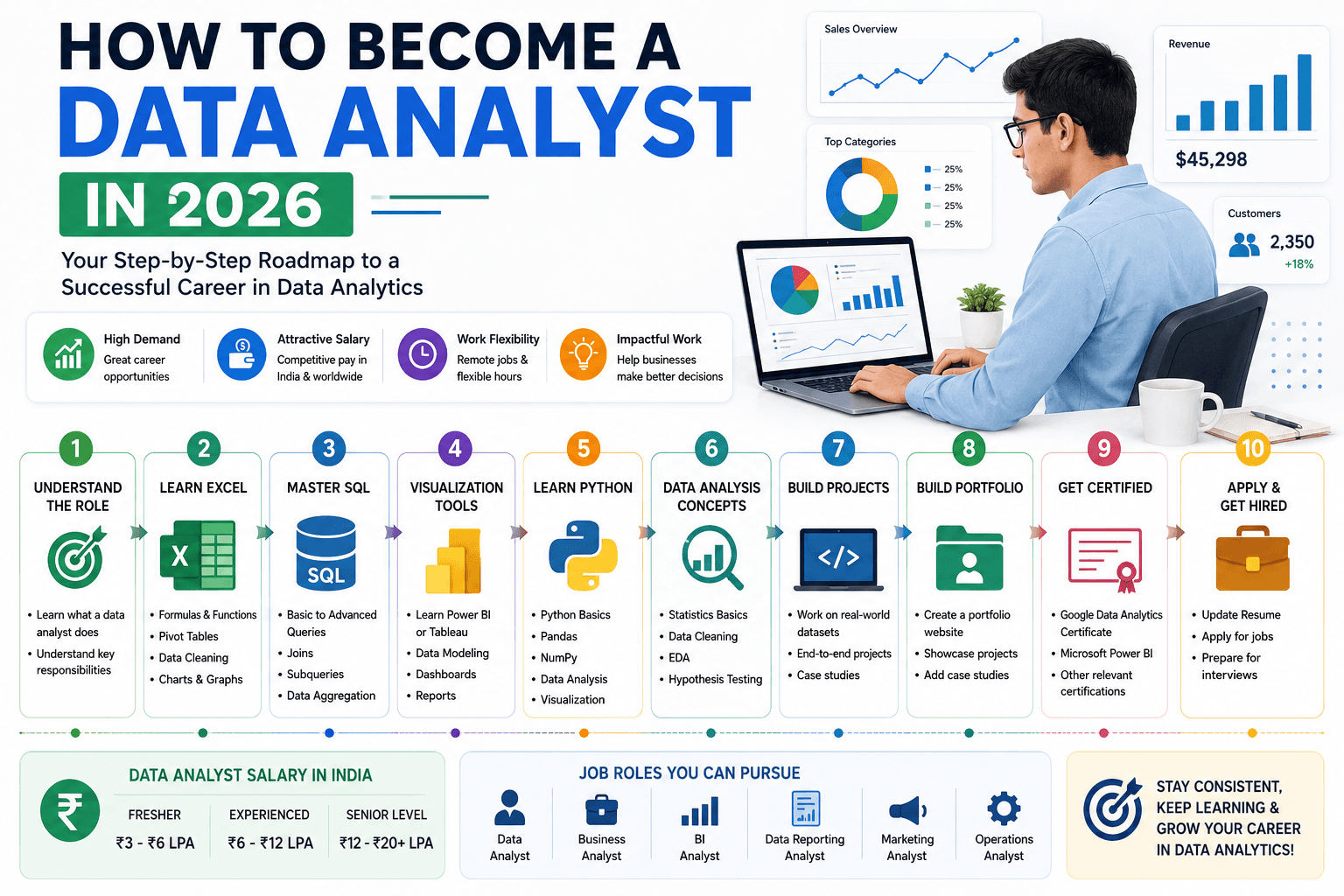
Step-by-Step Roadmap: How to Become a Data Analyst
Follow these steps to start your journey:
- Learn the Fundamentals – Start with SQL and Excel. Many free resources are available online, including our courses.
- Master a Programming Language – Python is beginner-friendly and widely used. Focus on libraries like Pandas, NumPy, and Matplotlib.
- Understand Statistics – Take an introductory statistics course. Concepts like mean, median, correlation, and p-values are essential.
- Get Hands-On with Data – Practice on real datasets from platforms like Kaggle. Build projects that showcase your skills.
- Learn Data Visualization – Create dashboards using Tableau or Power BI. Visual storytelling is a key skill.
- Build a Portfolio – Share your projects on GitHub or a personal website. Include 3-5 projects that demonstrate different skills.
- Apply for Internships or Entry-Level Jobs – Look for titles like "Junior Data Analyst" or "Data Analyst Intern." Tailor your resume to highlight relevant skills.
Certifications and Courses
While a degree helps, many successful data analysts come from non-traditional backgrounds. Certifications can boost your credibility. Consider:
- Google Data Analytics Professional Certificate
- IBM Data Analyst Professional Certificate
- Microsoft Certified: Data Analyst Associate
- Our own data analytics bootcamp
These programs teach practical skills and often include portfolio projects.
Salary and Job Outlook
Data analyst salaries vary by experience and location. In India, entry-level analysts earn around ₹4-6 LPA, while experienced professionals can earn ₹10-15 LPA or more. Globally, the median salary in the US is about $70,000 per year. The Bureau of Labor Statistics projects 23% growth from 2022 to 2032, much faster than average.
Common Mistakes to Avoid
When learning how to become a data analyst, avoid these pitfalls:
- Ignoring SQL – SQL is the most frequently used tool in data analysis.
- Overcomplicating Tools – Start with basics; don't try to learn every tool at once.
- Neglecting Communication – Your analysis is only valuable if others understand it.
- Not Building a Portfolio – Employers want to see your work, not just your resume.
Conclusion
Becoming a data analyst in 2026 is an achievable goal if you follow a structured approach. Focus on building a strong foundation in SQL, Excel, and Python, practice with real data, and create a portfolio that showcases your skills. Remember, the journey is a marathon, not a sprint. Start today, and you'll be well on your way to a rewarding career. For more guidance, check out our other articles on data analytics careers.