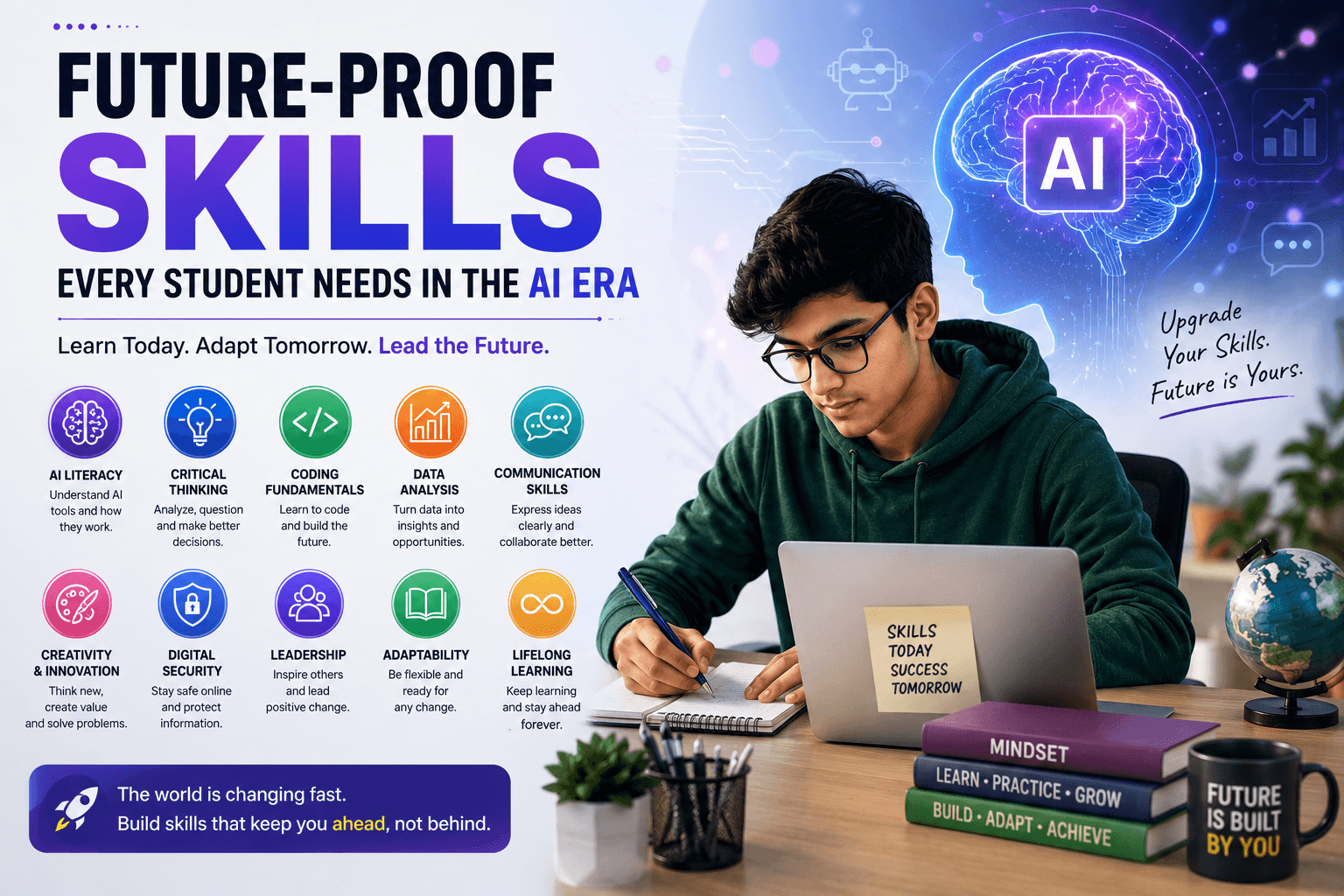
Future-Proof Skills are becoming essential for every student in today's AI-driven world. As artificial intelligence continues to transform education, careers, and workplaces, students must develop the right skills to stay competitive. From AI literacy and critical thinking to communication and problem-solving, these future-proof skills will help you succeed in 2026 and beyond.
Introduction
Artificial intelligence is transforming every industry—from healthcare to finance, education to entertainment. As a student, you might wonder: Will AI take my job? The truth is, AI will not replace humans, but it will change the skills we need to succeed. The key is to focus on Future-Proof Skills—abilities that remain valuable no matter how technology evolves. In this article, we'll explore the top skills every student should develop to thrive in the AI era. By the end, you'll have a clear roadmap to future-proof your career.
1. Critical Thinking and Problem-Solving
While AI can process data and recognize patterns, it lacks the human ability to think critically. Critical thinking involves analyzing information, questioning assumptions, and making reasoned decisions. For example, when AI provides a recommendation, a critical thinker evaluates its validity and context. To build this skill, practice breaking down complex problems into smaller parts, consider multiple perspectives, and debate ideas with peers. At GreyAcademy, our courses emphasize project-based learning that sharpens your analytical mind.
Why It Matters
According to the Wikipedia article on critical thinking, it is considered a cornerstone of education and employment. In a world where AI handles routine tasks, humans are needed for higher-order thinking.
2. AI Literacy and Technical Fundamentals
You don't need to become a programmer, but understanding how AI works is a Future-Proof Skill. AI literacy means knowing the basics of machine learning, data ethics, and the limitations of AI. For instance, you should be able to explain what a neural network is and why biased data leads to biased AI. Start with free resources like Andrew Ng's AI For Everyone course on Coursera, and then browse all courses on GreyAcademy to dive deeper into Python or data science.
Hands-On Practice
- Learn the basics of Python: it's the most popular language for AI.
- Experiment with no-code AI tools like Teachable Machine.
- Take a short course on AI ethics.
3. Creativity and Innovation
AI can generate art, music, and text, but it lacks true creativity—the ability to connect unrelated ideas and produce something novel. Creativity is a distinctly human advantage. To boost your creative muscles, engage in divergent thinking exercises, such as brainstorming multiple solutions to a problem. Keep a journal of ideas, and don't be afraid to fail. Many successful innovations come from trial and error.
"Creativity is intelligence having fun." — Albert Einstein
At GreyAcademy, we offer articles on creative thinking that can inspire you to think outside the box.
4. Emotional Intelligence and Empathy
AI can simulate conversation, but it cannot feel emotions. Emotional intelligence (EQ)—the ability to recognize, understand, and manage your own emotions and those of others—is a critical Future-Proof Skill. High EQ leads to better teamwork, leadership, and customer service. Practice active listening, show genuine curiosity about others' feelings, and seek feedback on your interpersonal skills.
Key Components of EQ
- Self-awareness: Know your strengths and weaknesses.
- Self-regulation: Manage your reactions.
- Motivation: Stay driven by intrinsic goals.
- Empathy: Understand others' perspectives.
- Social skills: Build healthy relationships.
5. Adaptability and Lifelong Learning
The pace of change is accelerating. Technologies that are cutting-edge today may be obsolete tomorrow. Adaptability and a commitment to lifelong learning are essential Future-Proof Skills. Embrace a growth mindset: see challenges as opportunities to learn. Set aside time each week to explore new topics, whether through online courses, podcasts, or books. GreyAcademy's platform is designed for continuous learning, with courses updated regularly to reflect industry trends.
According to the World Economic Forum's Future of Jobs Report, 50% of all employees will need reskilling by 2025 due to AI and automation.
6. Digital Communication and Collaboration
In a hybrid world, the ability to communicate clearly across digital channels is vital. This includes writing concise emails, leading virtual meetings, and using collaboration tools like Slack or Trello. Digital communication is not just about technology—it's about conveying ideas effectively. Practice writing summaries, giving presentations, and giving constructive feedback online. These skills are highly sought after in the modern workplace.
Conclusion
The AI era is not something to fear—it's an opportunity to focus on what makes us uniquely human. By developing these Future-Proof Skills, you'll be prepared for any career path you choose. Start today: pick one skill from this list, set a small goal, and take action. Remember, the best time to learn was yesterday; the next best time is now. Explore GreyAcademy's resources and begin your journey to a future-proof future!
Frequently Asked Questions
What are Future-Proof Skills?
Future-Proof Skills are abilities that remain valuable despite technological changes. They include critical thinking, creativity, emotional intelligence, and adaptability—skills that AI cannot easily replicate.
How can students develop these skills?
Students can develop them through online courses, practice, real-world projects, and by seeking feedback. Platforms like GreyAcademy offer structured learning paths for many of these skills.
Will AI replace all jobs?
No, AI will automate certain tasks but will also create new roles. The key is to focus on skills that complement AI, such as strategic thinking and human interaction.