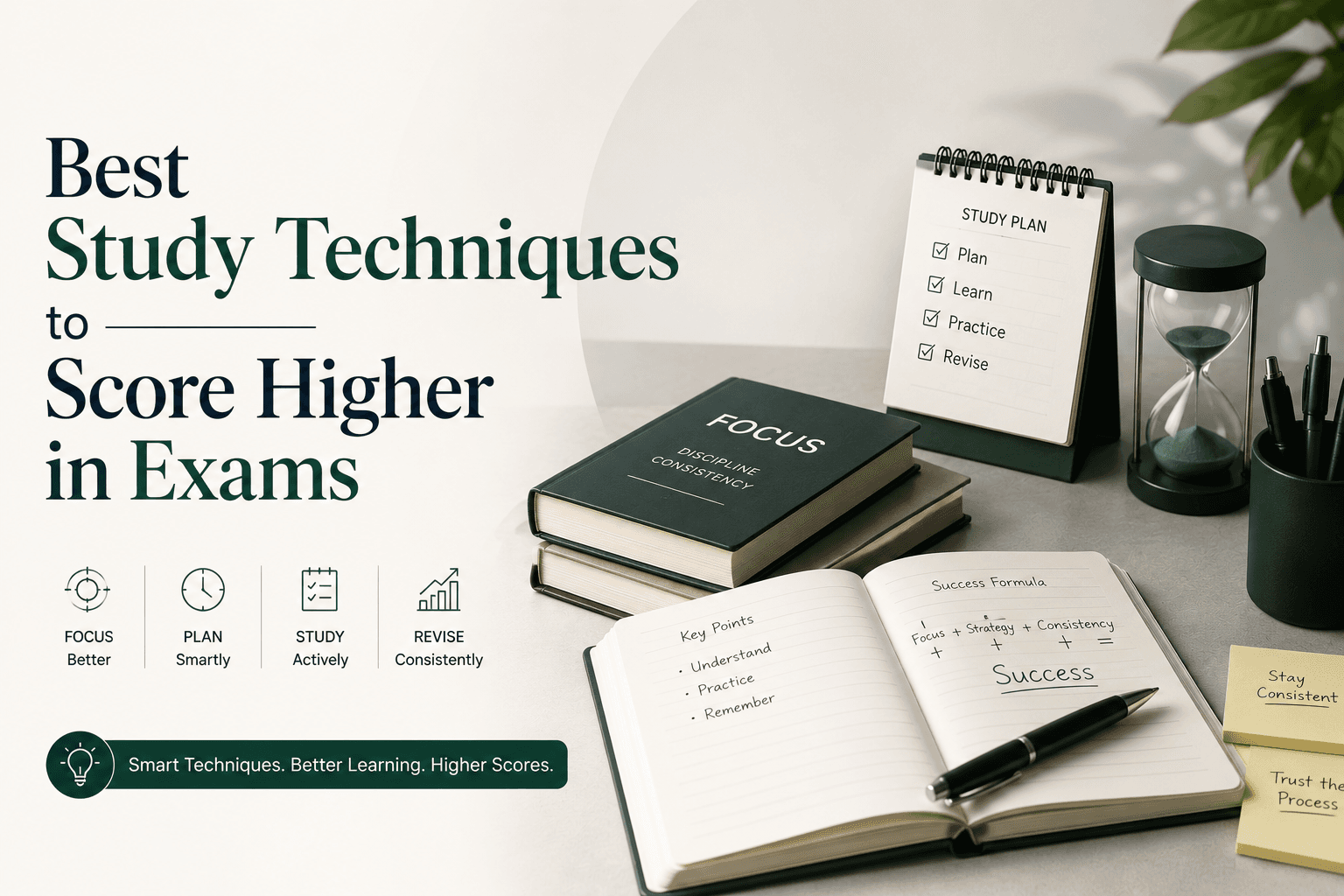
Best Study Techniques are essential for academic success and future career growth. From effective communication to teamwork and leadership, Best Study Techniques help build confidence, improve relationships, and prepare learners for real-world challenges. Developing these skills early gives students a strong foundation for personal and professional success.
Introduction
Are you tired of spending hours studying only to forget everything during the exam? You're not alone. The secret to scoring higher isn't studying more—it's studying smarter. In this guide, we'll explore the Best Study Techniques backed by cognitive science to help you retain information longer and perform better on tests. Whether you're a beginner or a seasoned student, these strategies will transform the way you learn. Let's dive in!
1. Active Recall: The Most Powerful Learning Technique
Active recall is the practice of actively retrieving information from memory rather than passively reviewing notes. It's one of the Best Study Techniques because it strengthens neural pathways and improves long-term retention.
How to Implement Active Recall
- After reading a chapter, close the book and summarize the key points from memory.
- Use flashcards with questions on one side and answers on the other. Apps like Anki can help.
- Test yourself regularly on past topics to reinforce learning.
According to a study published in Psychological Science, students who used active recall scored 50% higher on exams than those who only reviewed notes.
For more structured learning, explore our courses that incorporate active recall exercises.
2. Spaced Repetition: Timing Your Reviews for Maximum Retention
Spaced repetition involves reviewing information at increasing intervals over time. This technique combats the forgetting curve and ensures information moves from short-term to long-term memory.
Creating a Spaced Repetition Schedule
- Review material after 1 day.
- Then after 3 days.
- Then after 1 week.
- Then after 2 weeks.
- Then after 1 month.
Tools like Anki or Quizlet automate this process. As , spaced repetition is widely used in medical and language learning for its effectiveness.
Combine spaced repetition with other Best Study Techniques for optimal results. You can browse all courses on GreyAcademy to find programs that use these methods.
3. The Pomodoro Technique: Boost Focus and Prevent Burnout
Named after the tomato-shaped kitchen timer, the Pomodoro Technique breaks study sessions into focused intervals (usually 25 minutes) followed by short breaks. This method helps maintain concentration and reduces mental fatigue.
Steps to Use the Pomodoro Technique
- Choose a task to work on.
- Set a timer for 25 minutes.
- Work on the task until the timer rings.
- Take a 5-minute break.
- After four pomodoros, take a longer break (15-30 minutes).
This technique is particularly effective when combined with active recall. For example, you can do 25 minutes of active recall, then take a break. Pro tip: Use a physical timer to avoid distractions from your phone.
4. The Feynman Technique: Simplify Complex Concepts
Named after physicist Richard Feynman, this technique involves explaining a concept in simple terms as if teaching it to a child. If you can't explain it simply, you don't understand it well enough.
How to Apply the Feynman Technique
- Choose a concept you want to learn.
- Write an explanation in plain language.
- Identify gaps in your understanding and revisit the material.
- Simplify further until you can explain it effortlessly.
This is one of the Best Study Techniques for subjects like math, science, and programming. It forces you to truly grasp the material rather than memorize facts.
5. Interleaved Practice: Mix Subjects for Better Learning
Instead of studying one topic for hours (blocked practice), interleaving involves mixing different topics or types of problems in a single study session. This improves your ability to discriminate between concepts and apply the right solution.
Example of Interleaving
If you're studying math, mix problems from algebra, geometry, and trigonometry instead of doing all algebra first. Research shows that interleaving leads to 43% higher test scores compared to blocked practice, according to a study in Applied Cognitive Psychology.
For more on this, read more articles on our blog about advanced learning strategies.
6. Optimize Your Study Environment
Your environment plays a crucial role in how effectively you study. Here are some tips to create an ideal study space:
- Minimize distractions: Turn off notifications and keep your phone away.
- Use proper lighting: Natural light is best; avoid glare on screens.
- Keep it organized: A clutter-free desk reduces cognitive load.
- Background noise: Some people focus better with white noise or lo-fi music; experiment to see what works for you.
Conclusion
Mastering the Best Study Techniques is a game-changer for your academic performance. Start with active recall and spaced repetition, then incorporate the Pomodoro Technique, Feynman Technique, and interleaved practice. Remember, consistency is key. Apply these methods daily, and you'll see significant improvement in your exam scores. Ready to take your learning to the next level? Browse all courses on GreyAcademy and start your journey today!
Frequently Asked Questions (FAQ)
What is the most effective study technique?
Active recall is widely considered the most effective because it forces your brain to retrieve information, strengthening memory. Combine it with spaced repetition for the best results.
How many hours should I study per day using these techniques?
Quality over quantity. With techniques like the Pomodoro Technique, 2-4 focused hours per day can be more effective than 8 hours of passive review. Adjust based on your schedule and energy levels.
Can these techniques work for any subject?
Absolutely! While active recall and spaced repetition are universal, the Feynman Technique is especially useful for conceptual subjects, and interleaving works well for problem-based subjects like math and science.