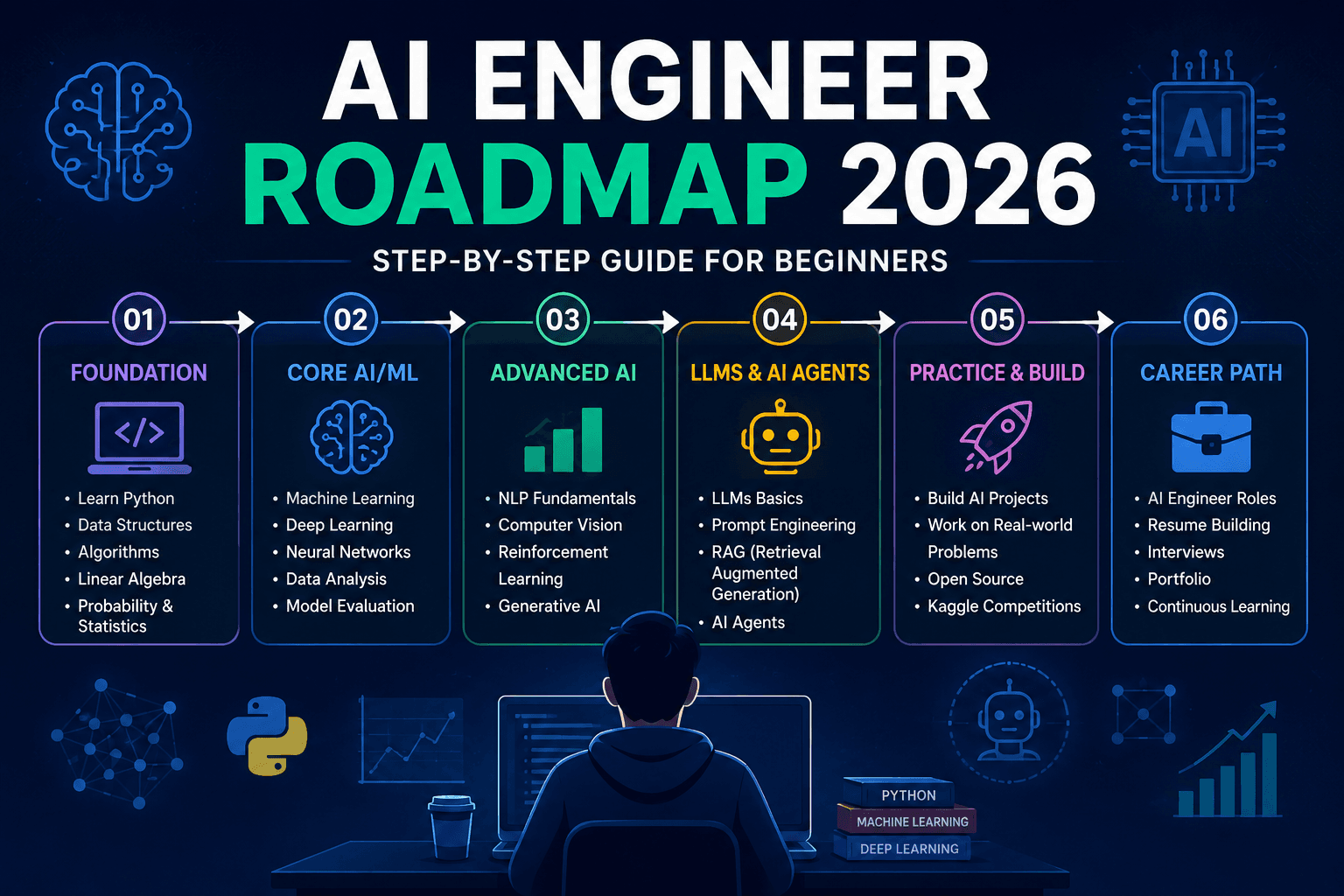
AI Engineer Roadmap 2026: Learn AI Step by Step
Artificial Intelligence is transforming industries across the world. From healthcare and finance to education and automation, AI is creating new opportunities and reshaping careers. As businesses increasingly adopt AI-powered solutions, the demand for skilled AI engineers continues to grow rapidly.
If you want to build a successful career in artificial intelligence, following a structured AI engineer roadmapis essential. This guide will help beginners understand what skills to learn, what technologies to focus on, and how to become job-ready in 2026.
What is an AI Engineer?
An AI Engineer is a technology professional who develops, trains, and deploys artificial intelligence models and systems. AI engineers combine programming, machine learning, data analysis, and problem-solving skills to create intelligent applications.
Some common responsibilities include:
-
Building machine learning models
-
Training AI systems
-
Developing AI-powered applications
-
Working with large datasets
-
Creating chatbots and AI assistants
-
Deploying AI solutions in production
AI engineers are among the most in-demand professionals in the technology industry.
Step 1: Learn Programming Fundamentals
Programming is the foundation of every AI engineer roadmap.
Before learning machine learning or AI models, you must become comfortable with coding concepts.
Recommended Topics
-
Variables and Data Types
-
Loops and Conditions
-
Functions
-
Object-Oriented Programming
-
File Handling
-
Error Handling
Best Language for AI
Python is the most popular programming language for artificial intelligence because it is easy to learn and has a large ecosystem of AI libraries.
Popular Python libraries include:
-
NumPy
-
Pandas
-
Matplotlib
-
Scikit-Learn
-
TensorFlow
-
PyTorch
Mastering Python should be your first goal.
Step 2: Learn Mathematics for AI
Many beginners skip mathematics, but it plays an important role in AI development.
You do not need a PhD-level understanding, but basic concepts are necessary.
Important Topics
Linear Algebra
Used in machine learning models and neural networks.
Probability
Helps AI systems make predictions.
Statistics
Important for analyzing data and evaluating models.
Calculus
Useful for understanding optimization and neural network training.
A strong mathematical foundation will make advanced AI concepts easier to understand.
Step 3: Learn Data Analysis
AI models rely on data.
Before building machine learning models, you must learn how to collect, clean, analyze, and visualize data.
Key Skills
Tools to Learn
-
Pandas
-
NumPy
-
Excel
-
SQL
-
Power BI
Data analysis helps you understand patterns and prepare datasets for machine learning projects.
Step 4: Master Machine Learning
Machine learning is one of the most important stages in the AI engineer roadmap.
Machine learning enables computers to learn from data and make predictions without being explicitly programmed.
Core Concepts
Supervised Learning
Models learn using labeled datasets.
Examples:
-
Spam Detection
-
House Price Prediction
Unsupervised Learning
Models identify hidden patterns without labels.
Examples:
-
Customer Segmentation
-
Recommendation Systems
Reinforcement Learning
Models learn through rewards and penalties.
Examples:
Popular Algorithms
-
Linear Regression
-
Logistic Regression
-
Decision Trees
-
Random Forest
-
K-Means Clustering
Understanding machine learning concepts is essential before moving to advanced AI topics.
Step 5: Learn Deep Learning
Deep learning powers many modern AI applications.
It uses neural networks to process complex information and solve advanced problems.
Applications
-
Image Recognition
-
Speech Recognition
-
Autonomous Vehicles
-
Medical Diagnosis
Deep Learning Topics
-
Artificial Neural Networks
-
Convolutional Neural Networks (CNNs)
-
Recurrent Neural Networks (RNNs)
-
Transformers
Frameworks
Deep learning skills are highly valued in the AI job market.
Step 6: Learn Generative AI and LLMs
In 2026, generative AI is one of the fastest-growing fields.
Large Language Models (LLMs) power modern AI tools such as chatbots, content generators, and virtual assistants.
Concepts to Learn
-
Prompt Engineering
-
Tokenization
-
Embeddings
-
Fine-Tuning
-
Retrieval-Augmented Generation (RAG)
-
AI Agents
Popular LLM Platforms
-
OpenAI Models
-
Gemini
-
Claude
-
Llama
Understanding LLMs gives you a significant advantage in today's AI industry.
Step 7: Build Real-World AI Projects
Learning theory is not enough.
Employers want proof that you can apply your knowledge.
Beginner Projects
Intermediate Projects
-
AI Content Generator
-
Recommendation Engine
-
Voice Assistant
Advanced Projects
-
AI Agent Systems
-
Multimodal Applications
-
RAG-Based Chatbots
Projects help you strengthen your portfolio and improve practical skills.
Step 8: Learn Git and GitHub
Version control is an essential skill for modern developers.
Git and GitHub help you:
-
Track code changes
-
Collaborate with teams
-
Showcase projects
-
Build a professional portfolio
Many recruiters check GitHub profiles before hiring candidates.
Step 9: Understand AI Deployment
Many beginners can build models but struggle to deploy them.
Deployment allows users to access your AI applications online.
Technologies to Learn
Cloud Platforms
-
AWS
-
Google Cloud
-
Microsoft Azure
Deployment skills make you more valuable as an AI engineer.
Step 10: Build a Strong Portfolio
A strong portfolio can help you stand out from other candidates.
Your portfolio should include:
-
AI Projects
-
GitHub Repositories
-
Certifications
-
Technical Blogs
-
Case Studies
A portfolio demonstrates your practical experience and problem-solving abilities.
AI Engineer Salary in India
AI engineering is one of the highest-paying technology careers.
Average salary ranges:
Freshers
₹6–12 LPA
Mid-Level Professionals
₹12–25 LPA
Senior AI Engineers
₹25–50+ LPA
Salary depends on experience, technical skills, project quality, and company size.
Common Mistakes Beginners Make
Many students delay their progress by making avoidable mistakes.
Mistake 1
Learning too many technologies at once.
Mistake 2
Ignoring mathematics completely.
Mistake 3
Not building projects.
Mistake 4
Focusing only on tutorials.
Mistake 5
Skipping deployment and cloud technologies.
Avoiding these mistakes can accelerate your AI learning journey.
Best Resources to Learn AI
Free Resources
-
YouTube Tutorials
-
Kaggle
-
GitHub
-
Open Source Projects
-
AI Documentation
Paid Resources
Consistent practice is more important than collecting courses.
Conclusion
Following a structured AI engineer roadmap is the most effective way to build a successful career in artificial intelligence. Start with Python, mathematics, and data analysis. Then move toward machine learning, deep learning, generative AI, LLMs, and AI agents.
Focus on building projects, creating a portfolio, and continuously improving your skills. As AI adoption grows worldwide, professionals who follow a clear AI engineer roadmap will be well-positioned for exciting career opportunities in 2026 and beyond.