Introduction
AI and Machine Learning Explained is one of the most searched technology topics among students today. You've probably heard the terms Artificial Intelligence (AI) and Machine Learning (ML) in movies, news reports, social media, or even in your classroom. But what do they actually mean? Are they the same thing? And why should students care about them? In this beginner-friendly guide, we'll break down AI and Machine Learning in simple terms, explore their differences, and show how these technologies are already shaping your daily life and future career opportunities.
AI and Machine Learning Explained: Understanding Artificial Intelligence
To understand AI and Machine Learning Explained, it's important to first learn how machine learning fits within the broader field of artificial intelligence.
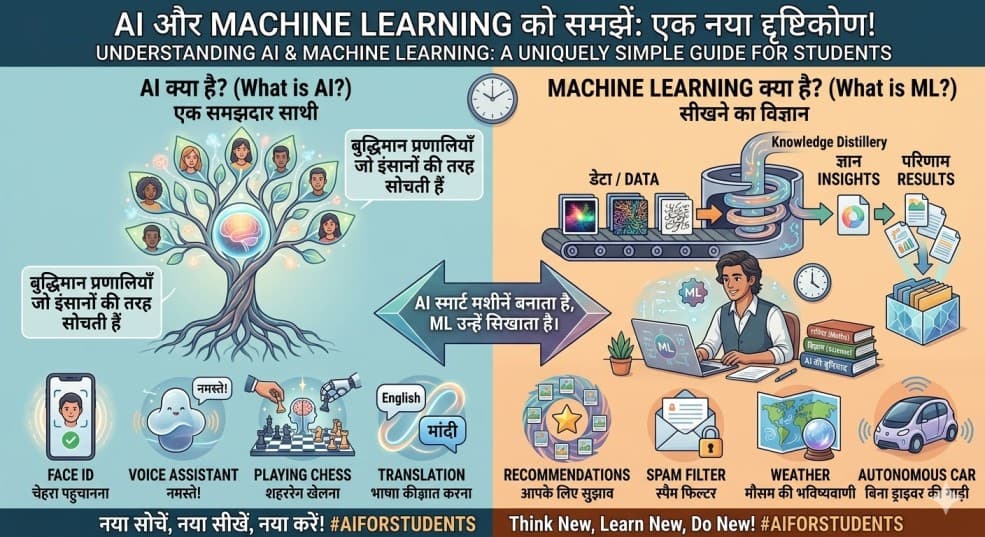
At its core, AI is about making machines smart. Imagine teaching a computer to think, learn, and make decisions the way humans do — except faster and without getting tired. AI is like giving a robot or software a brain that can solve problems, recognize patterns, and even understand language.
You interact with AI every day without realizing it. When your phone suggests the next word you’re about to type, that’s AI. When Netflix recommends a show you might like, that’s AI. When your email filters out spam, that’s AI too. It’s basically a computer trying to be helpful by mimicking human intelligence.
Think of AI as the big umbrella. Under that umbrella, there are many different tools and techniques — and one of the most exciting is machine learning.
What Is Machine Learning (ML)?
This example helps make
AI and Machine Learning Explained easier to understand because it shows how machines learn from experience rather than relying on fixed instructions.
Machine learning is a specific way to achieve AI. Instead of programming a computer with strict rules for every situation (which is impossible for complex tasks), we give it the ability to learn from data. In other words, we show the computer thousands of examples, and it figures out the patterns on its own.
For instance, if you want a computer to recognize cats in photos, you don’t write a rule like “if it has pointy ears and whiskers, it’s a cat.” Instead, you feed the computer millions of cat pictures (and non-cat pictures). The computer studies them, finds the common features, and eventually learns to identify a cat even in a brand-new photo it has never seen before.
How ML Works in Simple Steps
- Step 1: Collect data. Lots of it — text, images, numbers, or whatever you want the machine to learn about.
- Step 2: Train a model. You choose an algorithm (a kind of recipe) and feed the data to it. The algorithm adjusts itself to get better at predicting or classifying.
- Step 3: Test and improve. You check how well the model performs on new data, then tweak it until it’s accurate enough.
- Step 4: Deploy. The trained model is now ready to make decisions or predictions in the real world.
This process is why ML is so powerful — it can handle tasks that are too complicated to hard-code, like understanding speech, driving a car, or translating languages.
AI and Machine Learning Explained: What's the Difference Between AI and ML?
Here’s a simple way to remember: All machine learning is AI, but not all AI is machine learning. Think of AI as the whole field of “making machines smart.” Machine learning is one of the most popular ways to do that. There are other approaches too, like rule-based systems (where a programmer writes explicit if-then rules) or expert systems. But ML has become the superstar because it can adapt and improve on its own.
To put it in student terms: AI is like the dream of having a super-smart robot friend. Machine learning is the method you use to teach that robot new tricks without having to explain every single detail.
One of the best ways to understand AI and Machine Learning Explained is to look at the technologies you already use every day.
Real-Life Examples You Already Know
Let’s look at a few places where AI and ML show up in your daily life:
- Social media feeds: Instagram and TikTok use ML to decide which posts and videos to show you based on what you’ve liked before.
- Voice assistants: Siri, Alexa, and Google Assistant use AI to understand your questions and ML to get better at answering them over time.
- Online shopping: Amazon’s “customers who bought this also bought” feature is powered by ML analyzing millions of purchase patterns.
- Homework help: Tools like Grammarly or even some math solvers use ML to check your writing or solve equations.
These aren’t futuristic concepts — they’re already here, and they’re only getting smarter.
Why Should Students Learn About AI and ML?
Learning the basics of AI and Machine Learning Explained can help students prepare for future careers and make better use of modern technology.
You might be thinking, “Okay, cool, but I’m studying history / biology / art — why does this matter to me?” Great question. The truth is, AI is becoming as fundamental as reading and writing. It’s changing every industry, from healthcare (where AI helps detect diseases) to entertainment (where ML creates realistic video game characters).
Knowing the basics gives you a huge advantage, no matter what career you choose. You don’t have to become a programmer — just understanding how these tools work helps you use them smarter, ask better questions, and spot when something is biased or wrong. Plus, it’s a lot of fun to tinker with. There are free online courses (like the ones on GreyAcademy) that let you build your first ML model in minutes.
Common Misconceptions (Don’t Fall for These!)
Many myths exist around AI and Machine Learning Explained, which is why it's important to separate facts from science fiction.
Let’s clear up a few myths that often confuse students:
- “AI is just robots.” Nope. Most AI is software without a physical body — think of the algorithm that recommends your next YouTube video.
- “Machine learning is perfect.” Not even close. ML models are only as good as the data they’re trained on. If the data is biased or incomplete, the model will be too.
- “AI will replace all jobs.” It will change jobs, but it also creates new ones — like AI ethicists, data scientists, and prompt engineers. Learning about it now puts you ahead of the curve.
How to Get Started (Even If You’re a Total Beginner)
If you're interested in AI and Machine Learning Explained, hands-on projects and beginner courses are excellent starting points.
Ready to dive deeper? Here are three easy steps:
- Play with no-code tools. Websites like Teachable Machine let you train a simple image classifier using your webcam — no coding required.
- Take a beginner course. GreyAcademy offers short, fun modules on AI basics, Python for ML, and real-world projects. Start with AI Foundations and you’ll be building your own chatbot in no time.
- Read and ask questions. Follow blogs, join student AI clubs, and don’t be afraid to experiment. The best way to learn is by doing.
Conclusion
After exploring AI and Machine Learning Explained, it's clear that these technologies are not magic—they are practical tools built using data, algorithms, and human creativity. Whether you want to become an engineer, a doctor, an artist, or an entrepreneur, understanding these technologies will give you a superpower. So start exploring, stay curious, and remember: every expert was once a beginner. The future is waiting — and it’s powered by AI.